INTRODUCING RIGHTLOADING
QoE-based Traffic Steering Across Mobile and Wi-Fi Networks
The Enea Aptilo Service Management Platform™ (SMP) is a comprehensive, vendor-neutral system designed to manage and monetize large-scale Wi-Fi services. Since 2001, SMP has been enhanced through over 100 deployments worldwide, demonstrating its proven expertise in delivering secure, scalable Wi-Fi solutions. Today, we highlight our latest innovation: QoE-based Traffic Steering Across Mobile and Wi-Fi Networks, strengthening our position as the leading provider of large-scale Wi-Fi service management solutions.
Enea Aptilo SMP remains one of the most widely deployed back-end systems for Wi-Fi offloading and service provider Wi-Fi. It is also available as a SaaS offering, with a dedicated instance for each customer on Amazon Web Services (AWS), providing the same robust functionality and flexibility. This allows customers to select and tailor the specific features they need—such as SIM authentication—and seamlessly integrate them with their existing systems.
Our Wi-Fi offloading solution, built on SMP, extends far beyond simple SIM-based authentication. It offers comprehensive support for a wide range of carrier-grade Wi-Fi features, including multitenancy B2B management—designed to expand Wi-Fi coverage for offloading—and OpenRoaming capabilities.
Innovation for Improved Operator Control in Wi-Fi Offloading
This innovation further solidifies Enea’s position as the world’s leading provider of Wi-Fi offloading solutions, enabling Mobile Network Operators (MNOs) and Mobile Virtual Network Operators (MVNOs) to proactively optimize user experience by dynamically offloading traffic between Wi-Fi and cellular networks.
Unlike traditional device-driven network selection, our QoE-based traffic steering utilizes real-time quality KPIs and/or historical data to ensure seamless, high-quality connectivity. This intelligent approach empowers operators to take control, unlocking new levels of network efficiency and enhancing user satisfaction by shifting the final decision-making in network selection from the device to the operator.
With one foot in the 3GPP ecosystem and the other in carrier Wi-Fi service management, Enea is currently the only vendor capable of providing this type of real-time QoE-based traffic steering across both mobile and Wi-Fi networks.
We retrieve session quality data from our Traffic Management solution and utilize the powerful policy engine within Enea Aptilo SMP to determine whether a specific user should be offloaded to Wi-Fi or kept on cellular. Furthermore, our traffic management solution ensures that operators can optimize the traffic remaining on the mobile network—such as reducing video traffic load by up to 20%.
Register now for this On-demand Webinar
Recording from the November 11, 2025 Webinar
This is a 30-minute webinar, with a Q&A session afterward. You are welcome to contact us if you have a question we did not answer.

Drivers for Wi-Fi Offloading in the 5G era
Offloading mobile traffic to Wi-Fi is more relevant than ever in the 5G era, driven by three main factors:
- Video content now accounts for approximately 75% of mobile traffic.
- Higher frequency bands in 5G make indoor coverage more challenging and costly.
- Mobile traffic is expected to grow ten times faster than revenues from 2023 to 2030, with traffic increasing at a compound annual growth rate (CAGR) of approximately 23%, while revenue growth remains between 1-3%.
This scenario creates a perfect storm for operators, who must find more cost-effective indoor coverage solutions. Wi-Fi offloading should be a no-brainer for MNOs and MVNOs—particularly those with an existing Wi-Fi footprint. It is the only indoor solution capable of transforming into a profit center while simultaneously reducing costs.
If Wi-Fi offloading is so advantageous, why aren’t all mobile operators already implementing it?
Since it’s Halloween time, let’s share what tends to scare operators the most with Wi-Fi Offloading.
The biggest concern is the “Device is King” issue. Operators often ask:
- What if the device connects to Wi-Fi even when cellular connection is good or better?
- If both mobile and Wi-Fi have strong quality, the device might prefer Wi-Fi, leaving the mobile network underutilized?
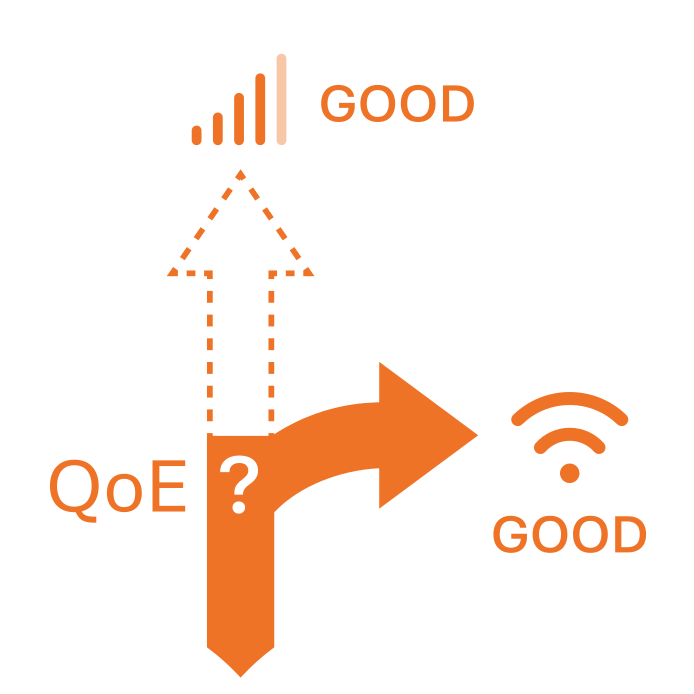 Both concerns about user experience and control are valid, but somewhat exaggerated. Devices are increasingly smarter at selecting the best connection—Wi-Fi or cellular. Over the years, we’ve observed this trend; however, it is indeed true that devices frequently auto-connect to known Wi-Fi networks—authenticated via the SIM card—when both cellular and Wi-Fi networks provide good quality connections.
To address concerns about losing control and preserving user experience, 3GPP has specified several architectures designed to grant more control—all of which involve backhauling traffic to the mobile core. Ultimately, however, the decision of network selection still rests with the device.
The only 3GPP standard that has seen widespread deployment is untrusted non-3GPP access, primarily used for Wi-Fi Calling. Very few operators utilize the trusted non-3GPP access architecture for backhauling data traffic to the mobile core. Instead, around 90% of Enea’s MNO and MVNO customers prefer to implement local traffic break-out. One reason is that the 3GPP-specified backhauling architecture is overly complex, requiring significant investments in specialized gateway functions such as WAG, TWAG, or TNGF. Additionally, backhauling typically only offloads the Radio Access Network (RAN), leaving the mobile core unaffected (And, many times more loaded with traffic due to better Wi-Fi coverage).
Move Contol to the Edge with Enea Aptilo SMP
With the unique capabilities of the Enea Aptilo SMP, we have long helped our customers overcome control issues by shifting management to the network edge rather than relying on backhauling traffic:
- We can retrieve policies from PCRF/PCF and enforce them locally via Wi-Fi gateways.
- When charging for Wi-Fi services, operators can manage quotas at the edge, with SMP checking out time and data quotas from BSS charging systems, including options for top-ups or returning unused quotas.
- Traffic can be redirected to central deep packet inspection (DPI) nodes or, when necessary, to lawful enforcement nodes, this is however not backhauling in the 3GPP sense.
- Many DPI use cases can also be handled at the edge, as modern Wi-Fi gateways from leading vendors often feature built-in DPI capabilities, some enabled by Enea’s iXEngine embedded DPI technology.
As a result, we have successfully enabled our MNO and MVNO customers to regain control over their Wi-Fi Offloading, bypassing the limitations of the 3GPP backhauling architectures.
Solving “The Device Is King” Issue
To address the “device is king” challenge and shift network selection control to the mobile operator, 3GPP has defined the Access Network Traffic Steering, Switching, and Splitting (ATSSS). Often regarded as the “Holy Grail” of offloading, ATSSS envisions using both Wi-Fi and mobile networks as a unified data plane, giving operators greater control from the mobile core. However, while promising, its implementation may never materialize—largely due to high costs and the ongoing political battle between MNOs and device manufacturers over who should be in control. The risk is that ATSSS could follow a similar path as the Access Network Discovery and Selection Function (ANDSF), remaining a theoretical concept rather than a practical solution.

Pragmatic traffic steering outside the 3GPP specifications is required!
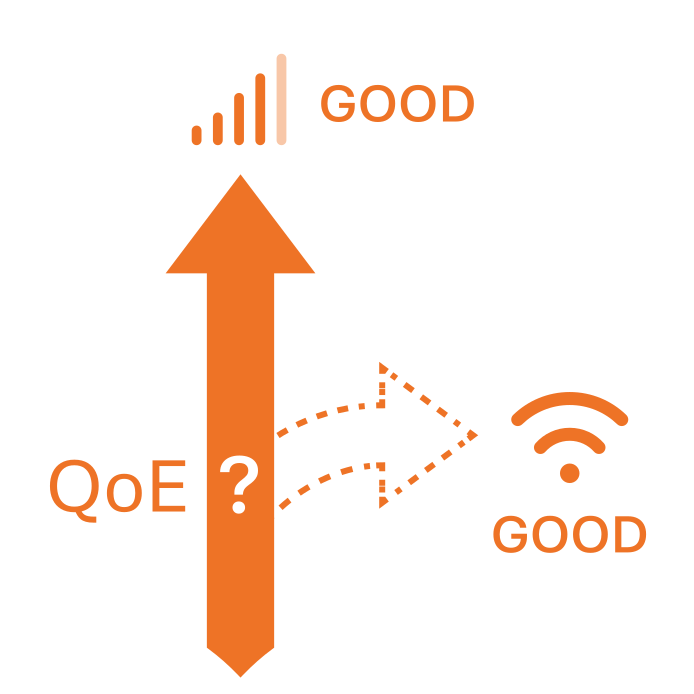 That is precisely what our innovation—QoE-based Traffic Steering Across Mobile and Wi-Fi Networks—delivers.
Nothing changes—the device will still decide whether to connect to Wi-Fi or mobile networks. However, our solution ensures that the device is not the sole decision-maker in network selection; the final decision is with the operator. We call this approach “Intelligent Rightloading,” and it comes in two variants.
Predefined Traffic Steering
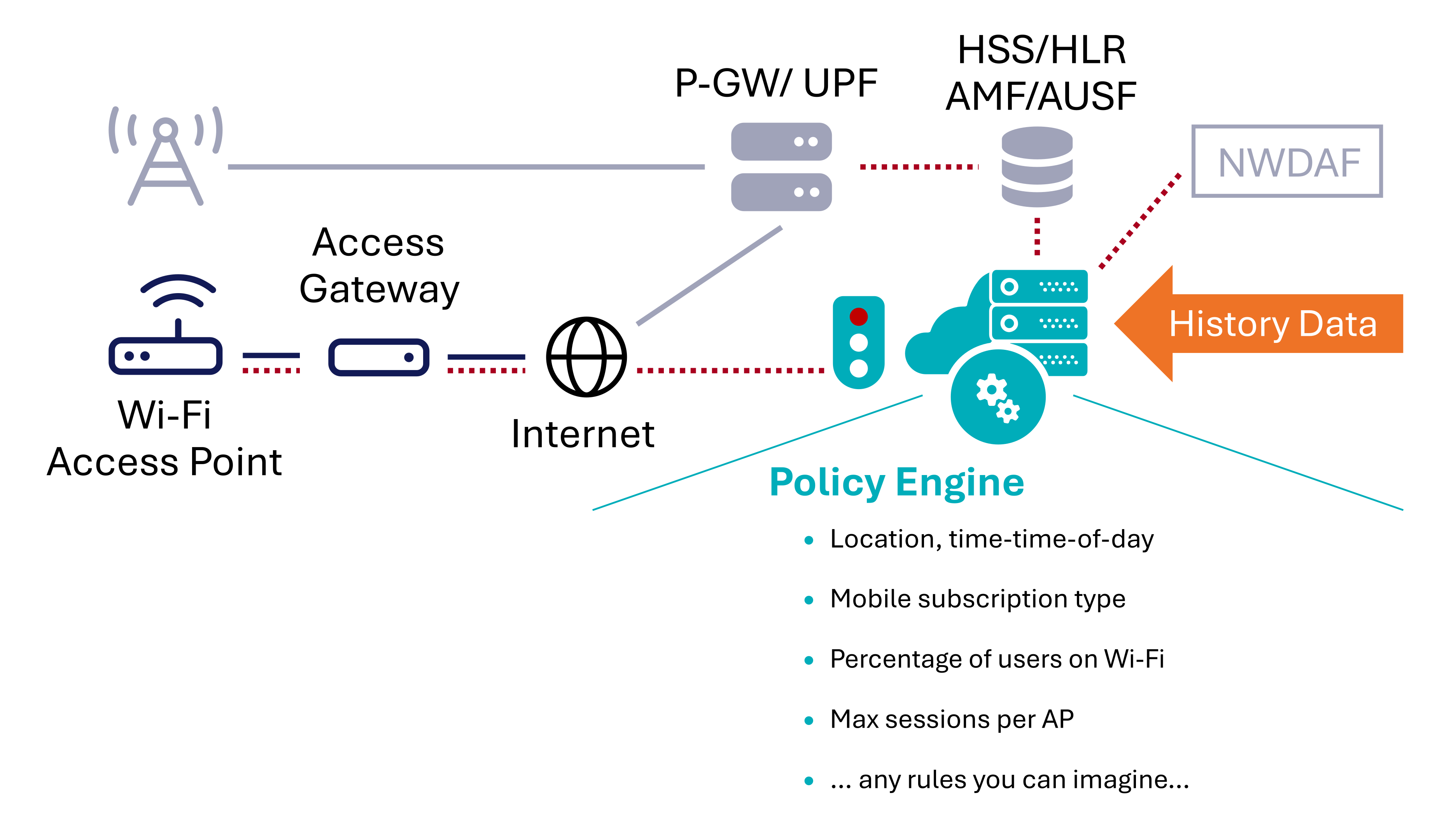
- Allows operators to prevent Wi-Fi connections for specific user groups, locations, times of day, or based on policies and historical data.
- Data Sources: Imported historical data or integration with analytics nodes such as NWDAF in 5G SA.
- Use Cases:
A. Prevent offloading during times and/or in locations where the mobile network is not congested.
B. Restrict offloading to certain subscription types.
C. Load balancing—e.g., only offload every third user at locations such as stadiums having both Wi-Fi and cellular coverage.
Real-time QoE-based Traffic Steering

- Cellular-centric: Offload traffic to Wi-Fi only when the mobile session quality falls below a defined threshold.
- Data sources (mobile):
1: Traffic management systems, such as Enea TM, providing session-specific real-time quality data from the mobile network and per location AI-based congestion level.
2: Future CAMARA API (work in progress).
4: Probe-based measurements.
- Data sources (mobile):
- Holistic approach: Continuously collect real-time quality data from both cellular and Wi-Fi networks. Offload traffic to Wi-Fi only if it offers better quality or if load balancing is required.
- Data sources for mobile as above.
- Data sources (Wi-Fi):
3a: Proprietary integrations with specific Wi-Fi vendors.
3b: Upcoming standards: The Wireless Broadband Alliance (WBA), of which Enea is a member, are currently
focused on developing a harmonized method for delivering Wi-Fi Access Network Metrics (ANM) via RADIUS.
4. Probe-based measurements.
For both variants to work, the device must be gently rejected when necessary. A hard rejection—such as not accepting a SIM authentication request—may cause the device not to attempt reconnection in the future. Enea has developed a method to gently reject devices, enabling seamless and controlled offloading decisions without disrupting user experience.