Chapter 6 – Satellite NTN Architectures
Will Satellite Technology Replace Mobile RANs?
This ongoing speculation in our industry has even prompted questions from industry analysts, such as, “If people use Wi-Fi for 80-90% of their connectivity needs, couldn’t satellites cover the remaining 10%?”
The Answer is no, and this is clearly articulated in an article by Aetha Consulting
They use SpaceX Starlink as a case to illustrate their point, comparing the capacity density per square kilometer of different 4G and 5G spectrum with that of Starlink’s initial fleet of 840 NTN satellites, the initially planned 12,000 satellites, and the more recently discussed final fleet of 42,000 satellites.
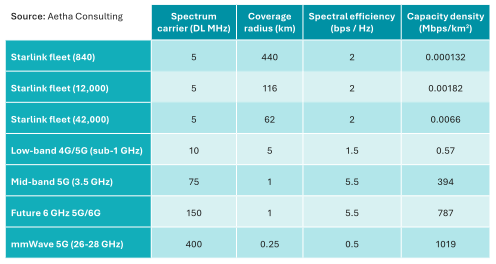
To achieve a capacity density comparable to that of even low-band carriers, Starlink would need 2×20 MHz of mobile spectrum and nearly a million satellites—well beyond any foreseeable constellation. Consequently, satellite NTN D2C services using standard devices and mobile spectrum may remain limited to messaging, emergency communications, and voice services for the foreseeable future; only time will tell how this will evolve. Furthermore, while cellular outdoor base stations face challenges with indoor coverage, satellites encounter even greater difficulties in penetrating buildings. Even if Wi-Fi is available at a location, it is often not controlled by the mobile operator. Therefore, cellular connectivity remains essential for delivering services in many indoor environments. Cellular connectivity is also essential for a country’s critical infrastructure.