


Data Sheet
Stratum UDR/SPR
Stratum Cloud Native Data Network layer enables the resilient, structured store, distribution of data in cloud native & hybrid environments.
Open
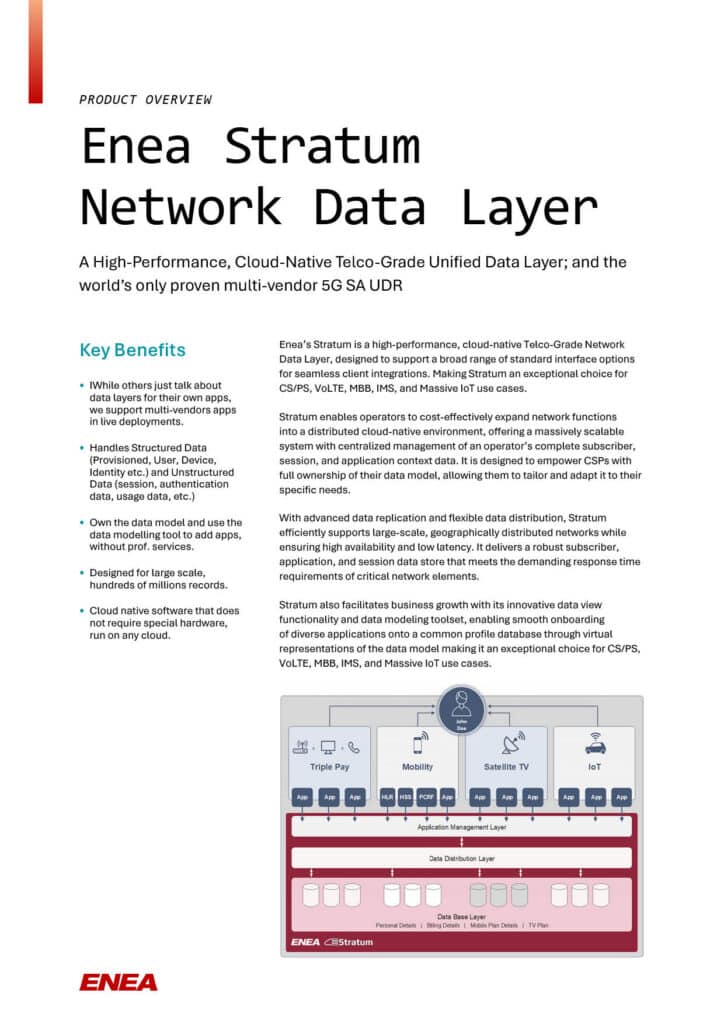

Network Data Layer
Stratum, a cloud-native distributed database for scalable 5G SA mobile networks
Communications service providers and enterprises moving to 5G Standalone (SA) are under pressure to launch new services faster, monetize network slices, and guarantee differentiated SLAs – all while controlling cost and complexity. At the heart of this transformation lies one critical capability: consistent, real-time access to user and session data across the entire 5G core. This is an evolution of the structured data challenges seen in earlier networks, but amplified by the scale, speed, and service diversity of 5G SA. Stratum, Our 5G SA User Data Repository (UDR), is a cloud-native database designed specifically for this need.
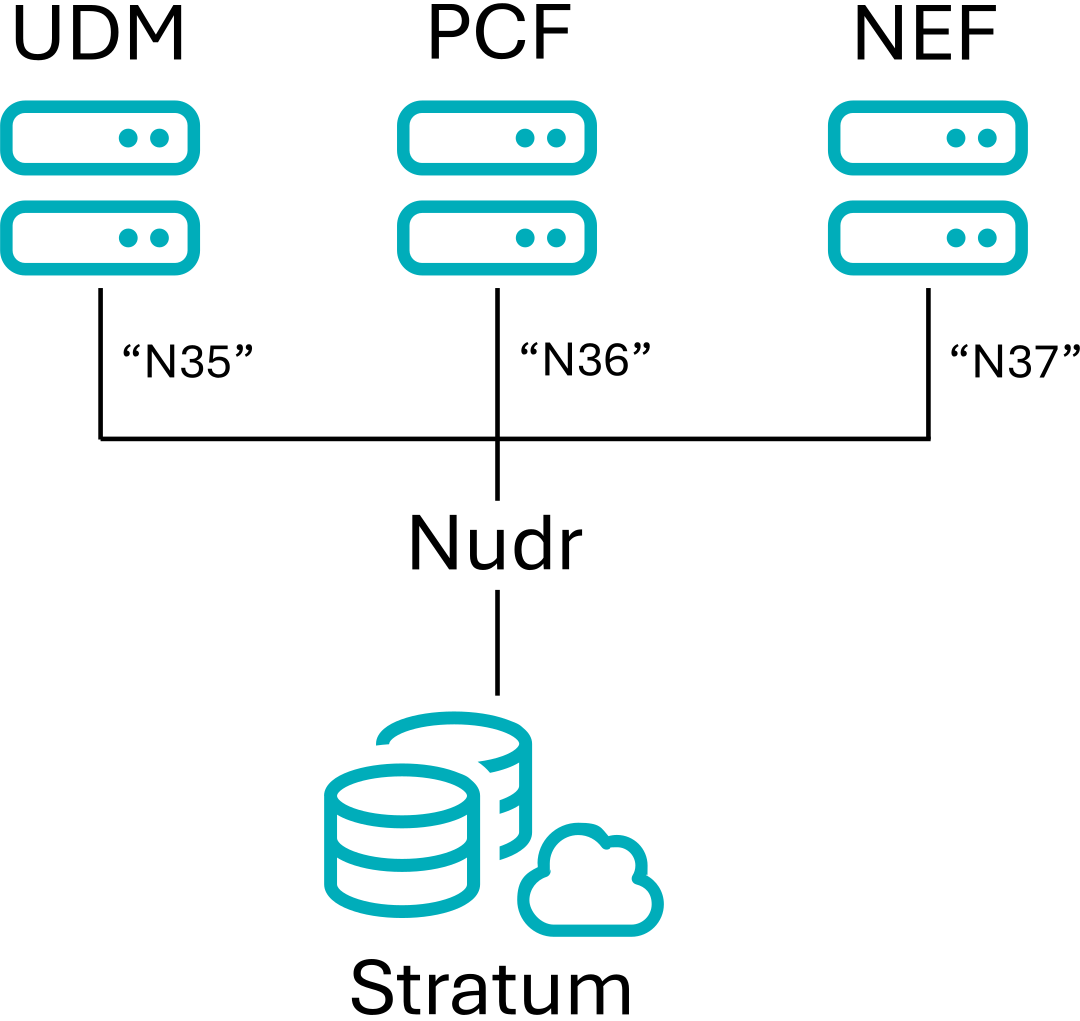
Stratum provides a unified, standards-compliant data layer for all 5G core functions – such as UDM, PCF, CHF, and NEF – giving them a single, authoritative source for subscription, policy, profile, and session information. This ensures that the foundational user and device data that networks rely on is always accurate, synchronized, and available.
Built on a modern microservices architecture, Stratum scales with traffic demand, supports geo-redundant deployments across multiple deployment options such as private or hybrid clouds, and enables zero-downtime upgrades. Open APIs and fine-grained data models allow you to integrate new apps, analytics, and exposure platforms without re-engineering your core.
With our 5G SA UDR, your data becomes a strategic asset – enabling smarter networks, differentiated services, and new revenue streams from day one of your 5G SA journey.

Stratum has been certified to run on Oracle Cloud Infrastructure (OCI), enabling telecom operators to deploy cloud-native 5G solutions with ease. The certification ensures that Stratum integrates seamlessly with Oracle’s cloud infrastructure, providing:
Stratum’s integration with OCI enables mobile network operators to rapidly scale their operations with a production-grade cloud environment that supports 5G and beyond.

Stratum isn’t just a data store—it’s the foundation for modern, dynamic, vendor-neutral telecom environments. By centralizing data and decoupling it from the control plane and applications, Stratum simplifies operations, enables innovation, and prepares your network for what’s next.
Would you like to know what Stratum can accomplish in your network? Schedule a meeting with our experts.
Each NF can access the same canonical data through 3GPP-standard interfaces rather than maintaining its own database. This prevents vendor-specific data models and enables operators to introduce new NFs without custom database integrations.
5G UDR stores structured data i.e. data with predefined schema. Covering defined user and session context data, like subscriber identities, subscription profiles, device associations, policies, i.e. foundational data required for user subscription, and policy management.
In contrast the 5G UDSF stores unstructured data i.e. data with non-shared/defined schema. Covering application specific session/state data such as dynamic session context, vectors, temporary state, session usage data, etc. belongs to a different function (e.g. an unstructured data store).
This separation ensures that structured data remains clean, consistent, and stable, while dynamic session data is handled separately, avoiding schema pollution and ensuring clarity. In Stratum the structured data layer and unstructured data layer can coexist but remain logically distinct.
Stratum is ideal for any operator or service provider migrating to 5G, cloud-native, microservice-based architectures – especially those planning multi-vendor, hybrid-cloud, edge-oriented, or private 5G / IoT deployments. It’s also well-suited for operators seeking to: reduce TCO by avoiding per-app data silos; scale horizontally; enable rapid deployment of new services; support network slicing; and manage subscriber, session, policy, and device data in a unified, secure, and efficient way.