


Watch this video to get an overview of the Enea Aptilo SMP Virtual Service Provider (VSP) functionality.

One network, many VLANs provided to tenants by B2B Customer (Virtual Service Provider)
Virtual Service Provider
Scaleable operator-managed corporate Wi-Fi and LAN. Operators can leverage ONE infrastructure and SSID while still allowing each of their B2B customers to act as a virtual service provider, handling the daily IT operations of their own business or residential customers. This is an excellent complement to our Operator Managed Guest Wi-Fi solution.
With Enea Aptilo SMP Virtual Service Provider (VSP) innovation, the operator gets a standardized and scalable way to sell managed corporate LAN and Wi-Fi services directly and through channels. Operators can offer a standardized network infrastructure with one SSID to their B2B customers. Through Virtual Local Area Network (VLAN) technology, each B2B customer acts as a Virtual Service Provider. The B2B customer handles the daily operations towards their own business or residential customers (tenants). Tenants get a private Wi-Fi network with secure access to internal networked resources such as printers and servers. It’s just as if they had their own network.
Enea Aptilo VSP is ideal for working with verticals such as Real Estate, Co-Working Offices, Apartments (MDU), and Shopping malls.
Enea Aptilo SMP Virtual Service Provider offers an unprecedented uniform and scalable way to sell managed Wi-Fi and LAN services to business customers. This is a two-level B2B service where the operator sells managed Wi-Fi and LAN services to their B2B customers, which sell these services to their customers (tenants). These three actors then share the administration of the service in a very effective manner.
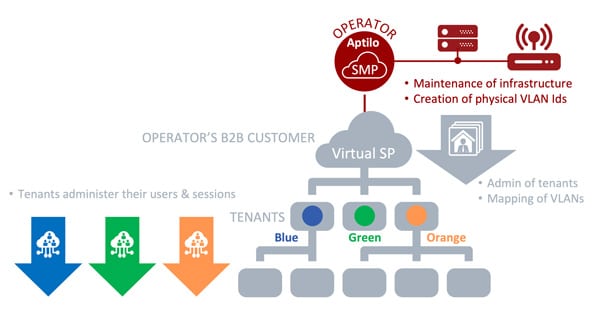
Administers and maintains Wi-Fi hardware, LAN, and Virtual LAN (VLAN) identifiers.
Sells the IT service (Wi-Fi and LAN) to their business and residential customers (tenants) and maps the correct VLAN identifier to each tenant.
Administer their users.
There is a huge potential for operators to offer managed Wi-Fi and LAN services. Some 90% of all businesses in the US have less than 20 employees, and it is the same around the world. These small businesses would be the ones to benefit the most from a managed IT service. However, it is impossible to reach profitability for this mass market. The cost of sales and maintenance of the service is too high.
What if the operator could move the sales and daily operations to other companies?
Think about it, companies such as co-working offices ’aggregate’ many small businesses. By offering managed IT services to them and letting them take care of the daily operation for their customers (tenants) as virtual service providers, you will open up a large part of the mass market of small businesses.
Optionally operators can offer a shared Guest Wi-Fi service as an additional service.
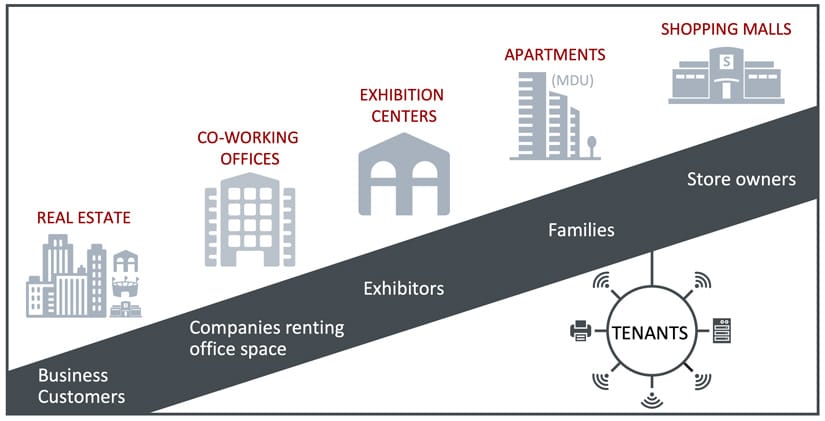
Service providers can use the Enea Aptilo SMP Virtual Service Provider innovation in many ways, but operators should focus on the ’small business aggregators.’ Here are a few good examples of a target market for our virtual service provider solution.
Real Estate owners can provide a managed private network service to their business customers just as they provide other amenities such as water and electricity.
Co-working offices can provide networks as a service. This is ideal as tenants, the companies that rent office space, can quickly grow and always have their virtual network at hand.
Exhibition centers can benefit from the software-defined flexibility and quickly provide a virtual private network to exhibitors.
Shopping malls can provide virtual private networks to stores for cash registers, printers, and electronic billboards on the same infrastructure used for visitors’ guest Wi-Fi.
It is also possible to reach the residential market. Companies running apartments (MDUs) can provide a managed Wi-Fi service to families. A helpful feature, in this case, is the hierarchical account structure in the Aptilo Service Management Platform™ (SMP), where family members and their devices can be arranged hierarchically under the same primary account. They can even share the same data quota.
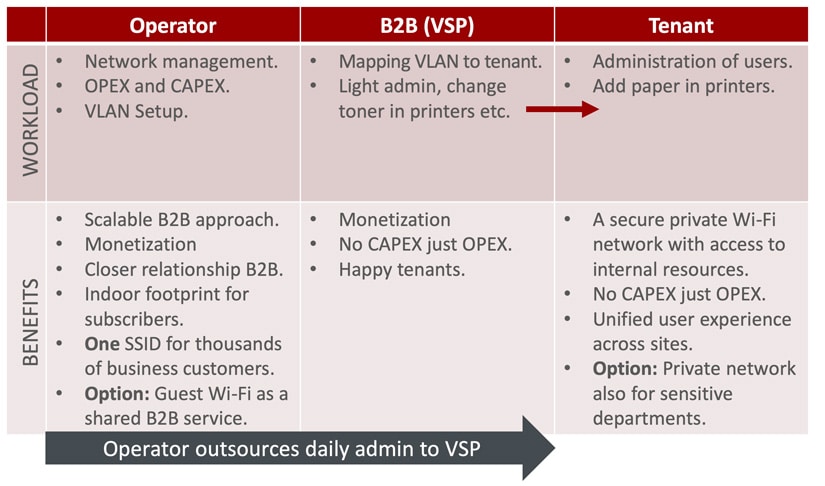
The table above summarizes the workload and benefits for the three actors in the virtual service provider concept. The key is the optimal distribution of the daily administration of the service. The tenants can enjoy a managed IT service profitable for the operator and the virtual service provider. Everybody wins.
Most modern operators of today have a system integrations arm, many times through recent acquisitions.
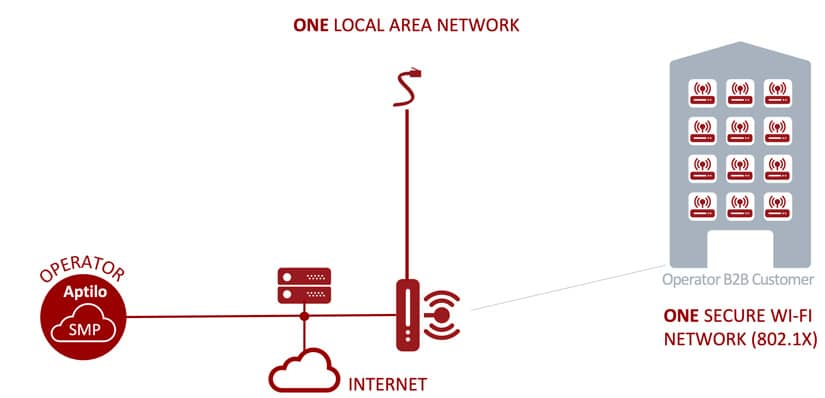
The operator deploys one local area network (LAN) and one secure Wi-Fi network (802.1x) at the B2B customer’s premise as a managed service.
The operator may also agree with the B2B customer to use the existing infrastructure and even take over the responsibility for it. This is possible since the Enea Aptilo SMP (software) and SMP-S (service on AWS) features specific support for all leading Wi-Fi vendors.
The operator (or the owner of the LAN) defines virtual LANs (VLANs) in the local network infrastructure, including Wi-Fi access points
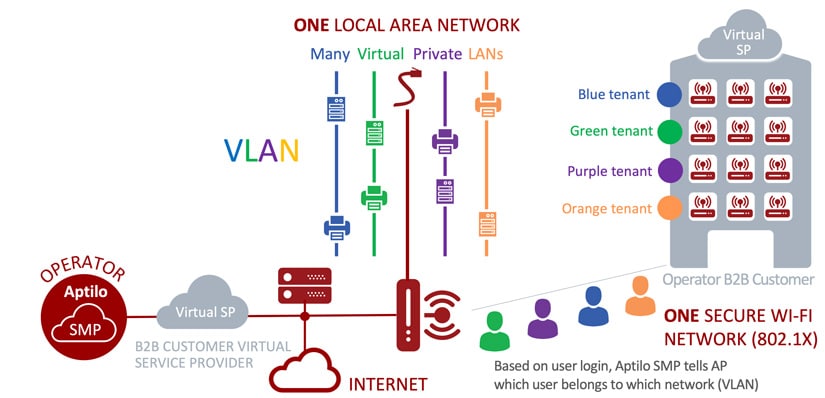
The operator utilizes the multitenant Enea Aptilo SMP Venue Wi-Fi Manager (VWM) to define the B2B customer as a Virtual Service Provider. The B2B customer now gets administrative rights to administer their customers (tenants) and map them to one of the defined VLANs. The B2B customer can also give administrative rights in their VLAN to allow tenants to administrate their own users and sessions.
When the mapping between VLANs and tenants is in place, all Wi-Fi users belonging to a particular tenant will get access only to their dedicated VLAN. Enea Aptilo SMP/SMP-S simply tells the Wi-Fi Access Point which VLAN each user belongs to in the authentication process. Although the traffic flows in the same physical cable, it is just like each tenant has their own cable (network).
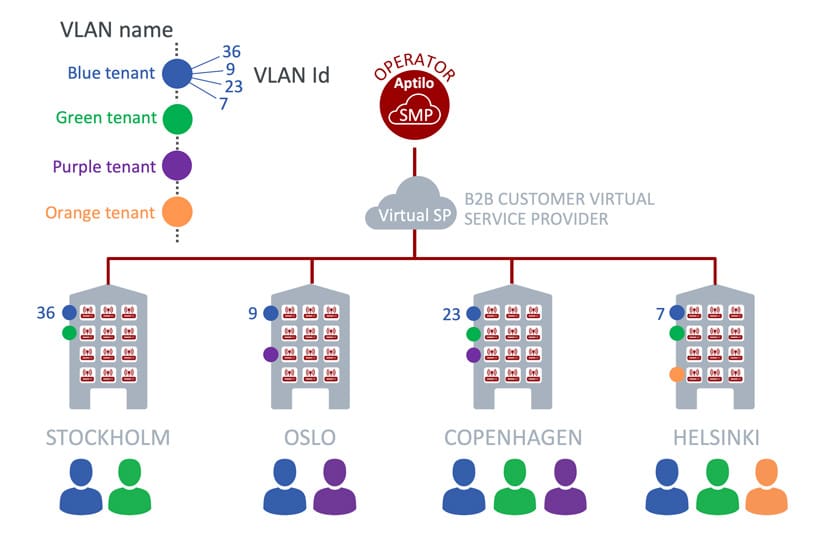
However, it is complicated for the Operator to maintain the same physical VLAN ID across multiple sites, especially in a dynamic environment such as co-working offices. This is why the Enea Aptilo SMP Virtual Service Provider solution has introduced a higher abstraction level, a VLAN name when mapping users to the correct VLAN in the system. The same VLAN name can be mapped to different physical VLAN Ids at various locations. This makes it easy to provide a service where all users access the correct VLAN over all locations.