


Enea Aptilo Wi-Fi SMP
Discover everything about Enea Aptilo Service Management Platform (SMP), the world’s leading platform for large-scale Wi-Fi services.
Explore

Create innovative services with
The Enea Aptilo Service Management Platform (SMP) is a carrier-grade system designed to manage data services with advanced authentication, policy control, and charging capabilities. This has positioned us as the world’s leading provider of large-scale Wi-Fi service management solutions and as an innovator in IoT, offering cutting-edge cellular IoT connectivity control and security services.
However, the possibilities extend even further with the integrated Enea AAA Server and the robust Policy Engine. A notable example of this is the Enea API Composition Engine (ACE), which significantly reduces integration challenges for mobile operators when launching API exposure services.
Continue reading about the core functions below, or click on the icons to explore the comprehensive product and service offerings enabled by Enea Aptilo SMP.
 Enea Aptilo SMP is designed for stability, scalability, and high availability, with built-in geographic redundancy. By separating the application logic from the communication layer, our system can easily scale with the addition of new nodes, precisely where increased capacity is needed.
In terms of performance, one thing is certain: what is considered high-performance today will be deemed average tomorrow. Whether using RISC-based, Intel®-based, proprietary servers, or hyperscalers, server hardware continues to evolve, with prices decreasing as speeds increase. To address this, the key is to achieve near-linear scalability when adding new servers, ensuring that capacity grows as needed.
As server hardware evolves rapidly, choosing a platform with the best price-performance ratio becomes crucial. Our system delivers carrier-class scalability by distributing workloads across different layers on standard Intel®-based servers. This provides a cost-effective solution, allowing additional performance to be gained by simply adding more servers. The widespread availability of Intel®-based architecture ensures economies of scale, avoiding the need to invest in high-performance, proprietary servers that may become obsolete.
Achieving close to linear scalability requires flexibility in both hardware and software. Our approach ensures this flexibility, allowing seamless expansion as your needs grow.
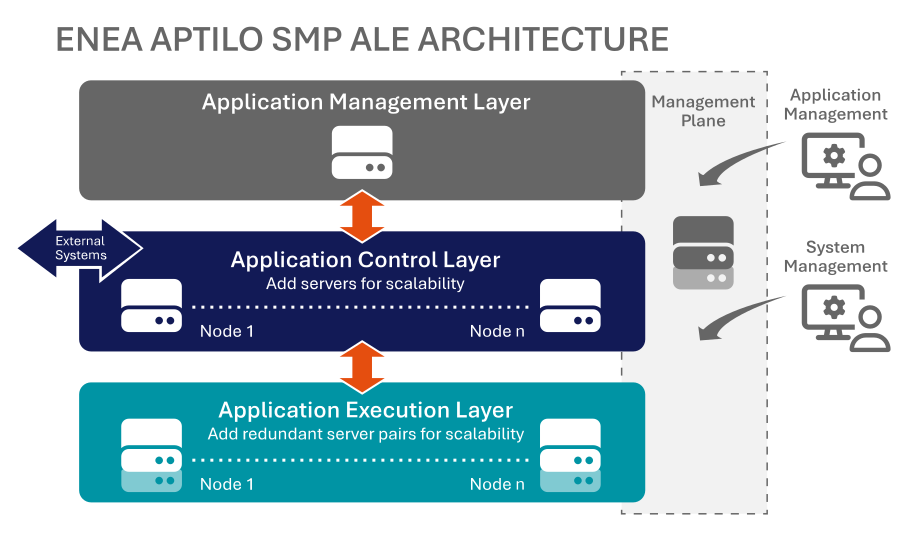
The Aptilo Long-term Evolution (ALE) architecture is built on three distinct layers:
By distributing these layers across multiple server nodes, we can efficiently increase capacity in critical areas while maintaining high availability through geographic redundancy. The system can scale from a setup of two redundant server pairs to a large, robust server cluster by adding more nodes.
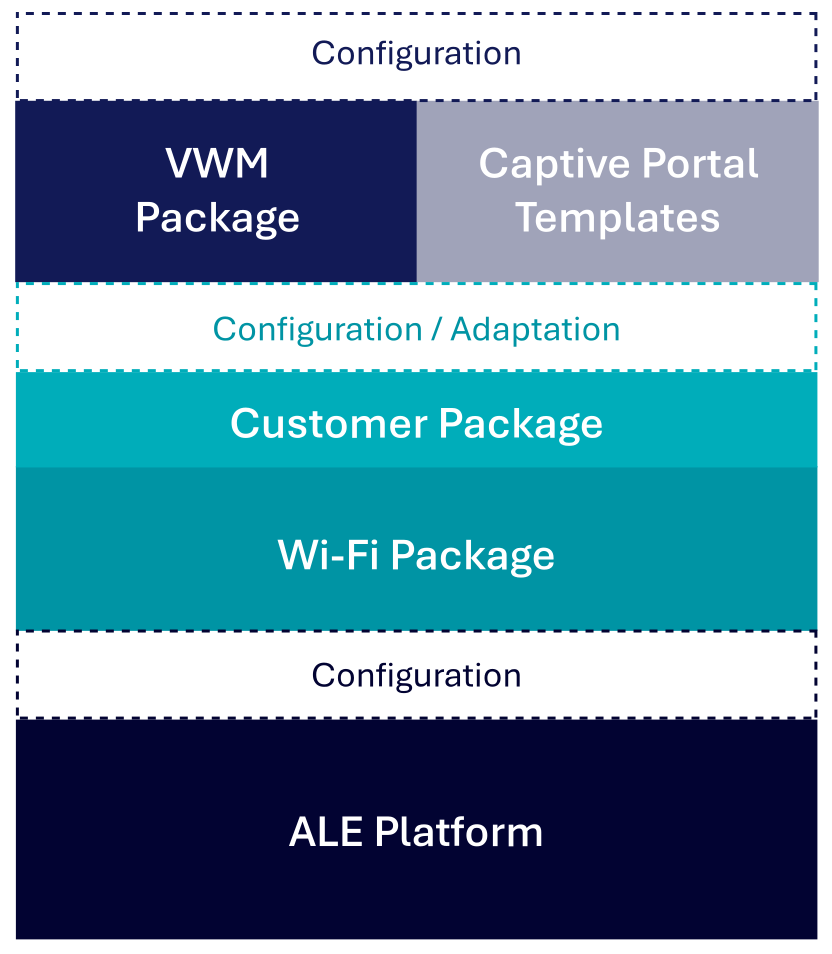
Enea has invested many years of development and market research to create a software architecture that allows us to deliver fast while maintaining a flexible platform that can be expanded to fit the customer’s unique requirements.
The core foundation behind the Enea Aptilo Wi-Fi service management platform, delivered as software (SMP) or as a service (SMP-S), is the ALE platform, the Wi-Fi software package, the Captive Portal, and the Venue Wi-Fi Manager. Each area has different strengths that provide value to the overall solution.
Support for new protocols can be easily implemented by adding a new protocol adaptor. Different APIs (SOAP, REST) can be implemented on top of these protocol adaptors.
The ServiceGlue is a core component of Enea Aptilo SMP, providing an intelligent solution for deploying wireless and IoT services. It offers rule-set-based configurable logic and an advanced database interface, enabling operators to adapt to evolving needs. ServiceGlue’s flexibility ensures seamless integration with existing systems, allowing operators to modify deployment logic through configuration.
Recognizing that new requirements are inevitable, ServiceGlue is designed for rapid adaptability. The solution allows operators to configure logic changes quickly, without the need for time-consuming software updates or implementing hard-coded changes. This flexibility is especially valuable when integrating with existing OSS/BSS and mobile core systems, allowing operators to avoid disruptions and leverage their existing infrastructure. Our vendor-agnostic approach includes pre-configured adaptations for leading Wi-Fi infrastructure and gateway vendors, enabling significant cost savings during deployment and supporting a phased integration process.
ServiceGlue incorporates advanced rule-set-based functions that can receive requests and triggers from gateways and other network nodes, such as policy, CRM, and provisioning systems. Based on these inputs, it can execute complex rule-based actions and return the required commands to external gateways and systems or post required data to databases. A single request can generate multiple actions, targeting different nodes to deliver the desired outcomes.
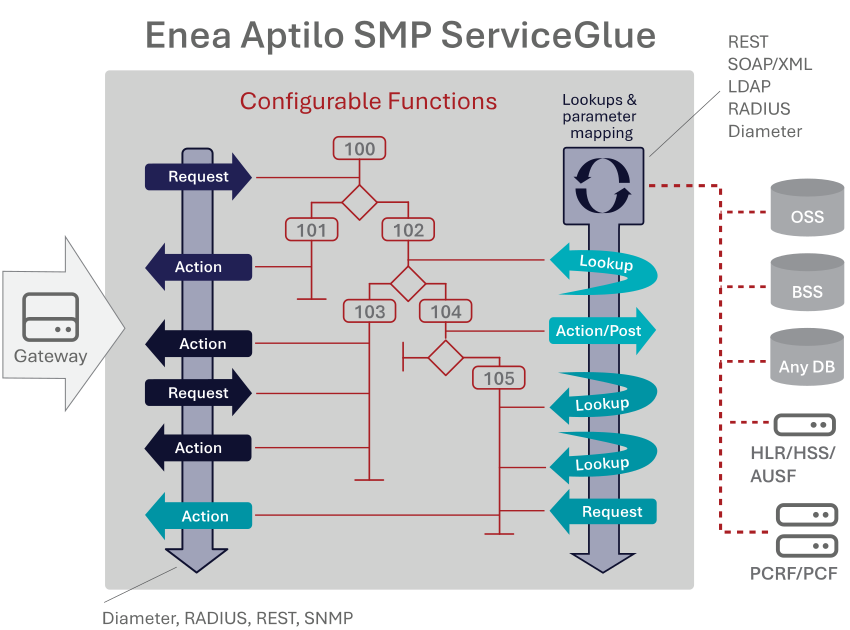
ServiceGlue also uses its intelligent database interface to perform multiple lookups, mapping parameters from various sources to those used in the network or other connected systems. These lookups may trigger the ServiceGlue to start additional functions, creating a highly flexible and adaptable logic framework.
For instance, a received request might initiate the primary function ‘100’. Depending on the data received, this function can trigger additional sub-functions, which in turn may start further functions to achieve the intended logic. This modular approach ensures that complex operations can be executed seamlessly.
ServiceGlue functions are initiated through three main types of triggers:
1. Network Events: Such as login or accounting requests.
2. Database Changes: For example, modifying an account parameter like “Charge for Wi-Fi” from ‘yes’ to ‘no’.
3. Timers: For tasks like session clean-ups at scheduled intervals.
With ServiceGlue acting as a “black box,” operators can introduce advanced functionalities with minimal disruption to their existing systems. This approach preserves existing infrastructure investments while enhancing capabilities for delivering first-class services.
The Enea Aptilo SMP base package allow customers to login and monitor various reporting functions such as aggregated reports and the status of the system. The system owner can login to check real time data from logs, sessions, history events, aggregations and SNMP data. This provides a comprehensive view for the system owner to understand the overall status of the system.
The Enea Aptilo SMP system reporting function features automatic data processing and aggregation, including demographics, usage information, and events.
Multitenancy analytics capability for Wi-Fi services with dashboards and diagrams are available in the Enea Aptilo Venue Wi-Fi Manager application. Flexible reports can be created for all data depending on the use case, whether for Wi-Fi analytics, IoT, or anything else.
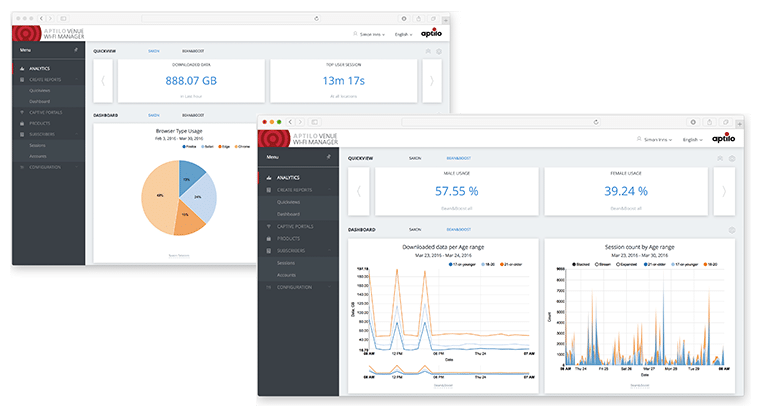
The information can be tailored for multiple groups of users, such as network administrators, customer care staff, customer support, managers, marketing, roaming partners, and venue owners.
Aptilo SMP features a very flexible way to add statistics counters. This makes it possible to add tailor-made statistics. The possibilities are endless as up to 100 counters can be added to our policy engine. Anything available in the system can be combined to provide the statistics needed.
For instance, the ruleset logic enables Aptilo SMP to count complex combinations of different parameters, such as counting the number of Web logins using prepaid accounts per browser type.
In addition to the analytics dashboard, it is also possible to distribute statistics through SNMP MIB.
The Enea Aptilo SMP contains many SNMP MIBs with thousands of objects. Of these, about 550 are Aptilo-specific objects. About 25 objects are traps; the others are used to monitor status and gather statistics from different system components.
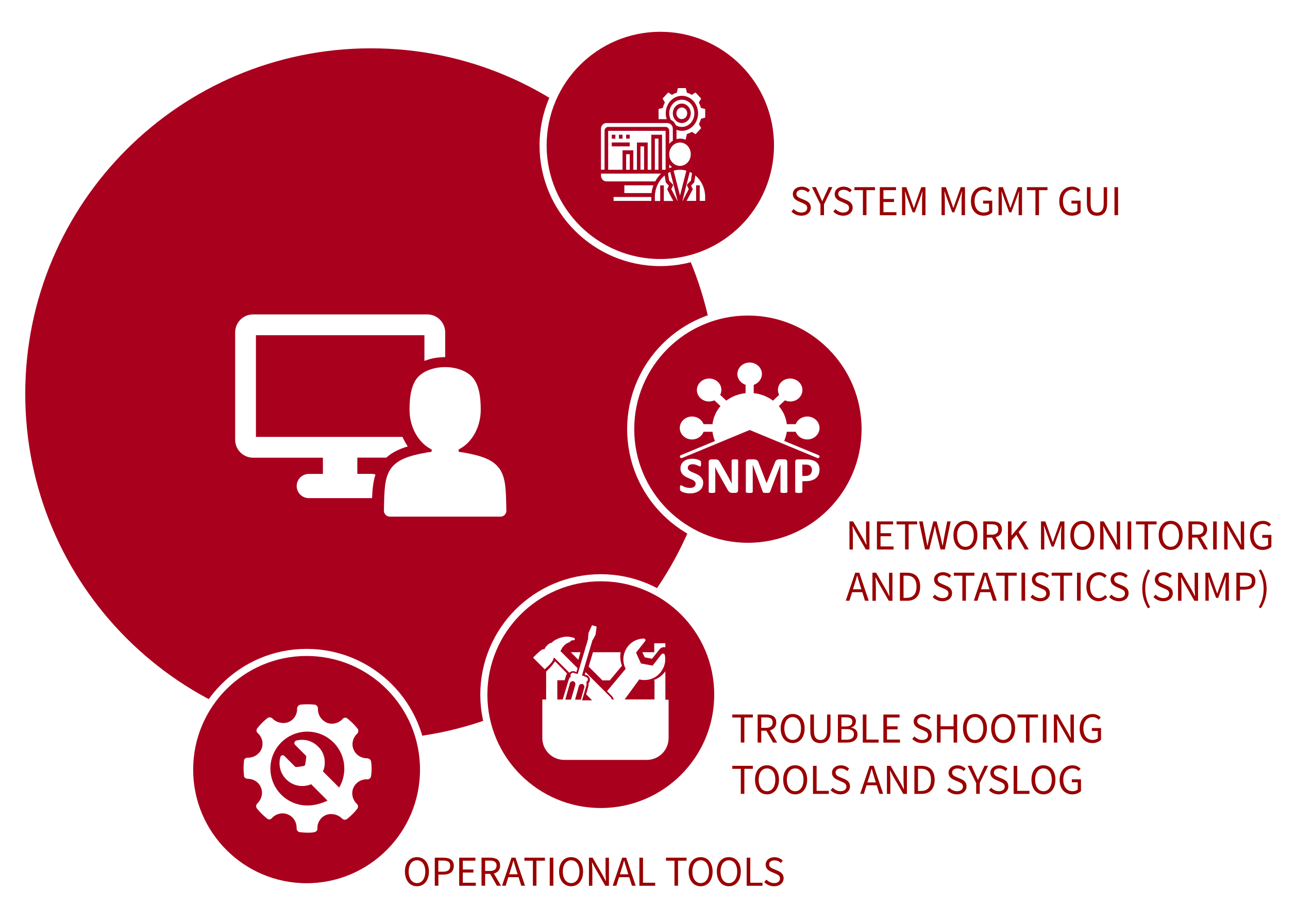 The Enea Aptilo SMP platform comes with a rich set of features for managing the service and the platform. From the management GUI, the system administrator gets the most important tools to manage general configurations, analyze logs, system health metrics, backups, service definitions, and integration points.
The SNMP MIBs allow system administrators to integrate Aptilo SNMP with their existing monitoring systems easily.
The Enea Aptilo SMP platform is built on a robust architecture that can manage millions of users and sessions and, at the same time be able to support and troubleshoot individual users.
Below are a few examples of tools that can be used to manage the Wi-Fi service.
The user and/or device activity in the Aptilo SMP is one of the most powerful troubleshooting tools available. The system allows you to define a user to analyze and provides a detailed description of what happens to the data related to this specific user as it passes through the solution.
Session Search is the way to get a list of active end-user sessions in an Aptilo SMP. An active session means any end-user that is either logged in to the Wi-Fi service or is currently trying to log in through a captive portal flow.
The Aptilo SMP keeps the GDPR-compliant log information required for troubleshooting in one consolidated system log for the complete installation. Logs from the different system nodes are all sent to the management node, where they can be searched in the SMP admin GUI. The logs can also be received over Syslog. Since the European GDPR legislation is one of the strictest in the world for protecting personal data, you will be covered to support other legislations globally.
The Audit Trail is a list of configuration actions that have been performed on the Aptilo SMP. All GUI activities are listed with the intended purpose of being able to identify who did what and when in the Aptilo SMP.
Aptilo SMP allows for searches in the configuration database. This makes it possible to find all occurrences of a configuration value and is valuable when the system administrator does not know where to configure the parameter in the SMP admin GUI.
The Enea Aptilo SMP also features several tools for smoother system operation.
The Aptilo SMP allows for collections of all configuration changes and accounts that have been added or changed and can manually or by a defined schedule create a backup based on this. This feature helps to secure the provided service and be able to quickly enable the service again in case of issues in the data center.
The Aptilo SMP platform supports online updates and upgrades and updates from locally downloaded installation files. Due to the scalable architecture of the Aptilo SMP, the platform’s upgrade doesn’t affect the provided service, as each functional node can be upgraded separately.
The Wi-Fi software package and portal products that typically contain customer-specific data will be updated separately on the management node once the changes to their specific package have been added.
The Aptilo SMP platform is installed with signed software and libraries to make sure that no unauthorized person makes any changes to the system. These files are checked through a built-in self-check service that makes it possible to track and identify a breach.