The Telco Database Trilemma
This excerpt is chapter 2 from Enea’s white paper “Scalable Database Design for 5G and Beyond”, published in April 2026. The whole paper can be accessed below.
Distributed systems of any kind are inherently forced to make design decisions that involve tradeoffs in maintaining a global unified state across all instances. Process failures, hardware issues, and the realities of operating over imperfect networks, where delays, outages, and complete partitions (communication between instances is severed) make such trade-offs unavoidable.
The CAP theorem, as one of the most well-known distributed system theorems, formalizes this fundamental limitation into a simple trilemma: in the presence of a network Partition (P), a replicated data store cannot simultaneously guarantee both strong data Consistency (C) and Availability (A).

Figure 1: Visualization of the CAP trilemma in a network partition.
The replicated data store must make a deliberate design choice: either preserve data consistency by rejecting the client write request or preserve availability by continuing to accept the write request even while replicas temporarily diverge. Because tolerance to network partitions is non-negotiable for geographically distributed deployments (sooner or later they will occur), real-world systems are ultimately defined around how they balance consistency and availability when communication between sites is disrupted.
Network partitions, however, are only one class of failure relevant to telecom database design. Even during normal operation, wide-area networks introduce latency, jitter, and packet loss. Any requirement for synchronous cross-site coordination increases client response times and exposes users to network variability. As a result, system designers must consider system design trade-offs not only for network partition failures but during steady-state operation as well.
The PACELC design principle extends the CAP theorem by describing these broader design tradeoffs:
- If a Partition (P) occurs, a system must choose between Availability (A) or Consistency (C).
- Else (E) – under normal operation – a system must choose between Latency (L) and Consistency (C).
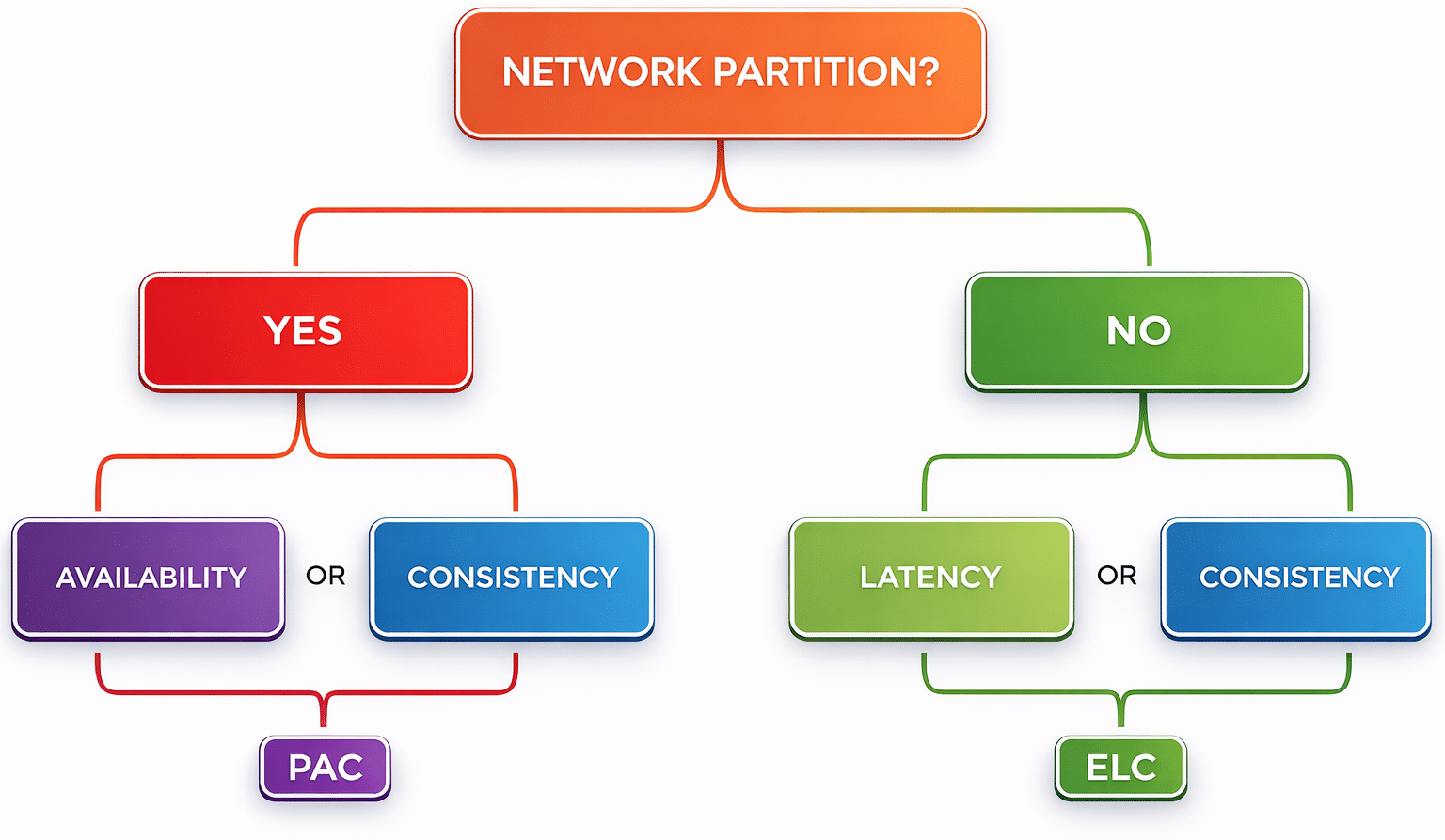
Figure 2: PACELC theorem decision diagram.
In other words: even in the absence of a network partition, maintaining strict data consistency across geographically distributed sites requires coordination over wide-area networks, and that coordination introduces additional client-visible latency.
From a PACELC perspective, systems that require consistently low response times in a dynamic, partitionable network are forced to relax their expectations of strict, global data consistency not only during failures, but during normal operation as well.

Learn More About Enea Stratum
Enea’s Stratum is the purpose-built cloud-native distributed database that puts these principles into practice. Already deployed by Tier-1 operators in North America and Europe, it handles hundreds of millions of subscriber records while delivering millions of transactions per second with telco-grade low latency and high availability. The difference between good enough and truly exceptional network performance increasingly comes down to the database layer operating beneath the surface. Make sure your infrastructure is ready for what’s next.
If you’d like to explore how Stratum can support your 5G and future 6G network requirements, visit: