Chapter 03
Key Technical Considerations for the AAA Replacement
When evaluating a modern and future-proof AAA platform, look beyond standard protocol compliance (RADIUS/Diameter). The differentiator is platform architecture.

Performance, Scalability and Resilience
The Requirement: The sheer volume of authentication and authorization requests in modern networks demand exceptional performance. Evaluate solutions based on demonstrated throughput (transactions per second), latency under load, intelligent overload protection, and the ability to scale near-linearly across CNF, VNF and bare metal standard servers. High availability (HA) and disaster recovery (DR) capabilities, including geo-redundancy, are non-negotiable to ensure continuous service delivery and minimal downtime. The system should be built with an asynchronous event-based processing, which fundamentally addresses high transaction rates and avoids bottlenecks experienced by older, thread-based systems where each incoming request is handled by a separate OS thread or a small pool of threads.
The Benefits: Outstanding scalability, availability, reliability and the ability to handle massive RADIUS transactions per second (TPS) volumes.
Build-in Business Logic Engine is Crucial for Success
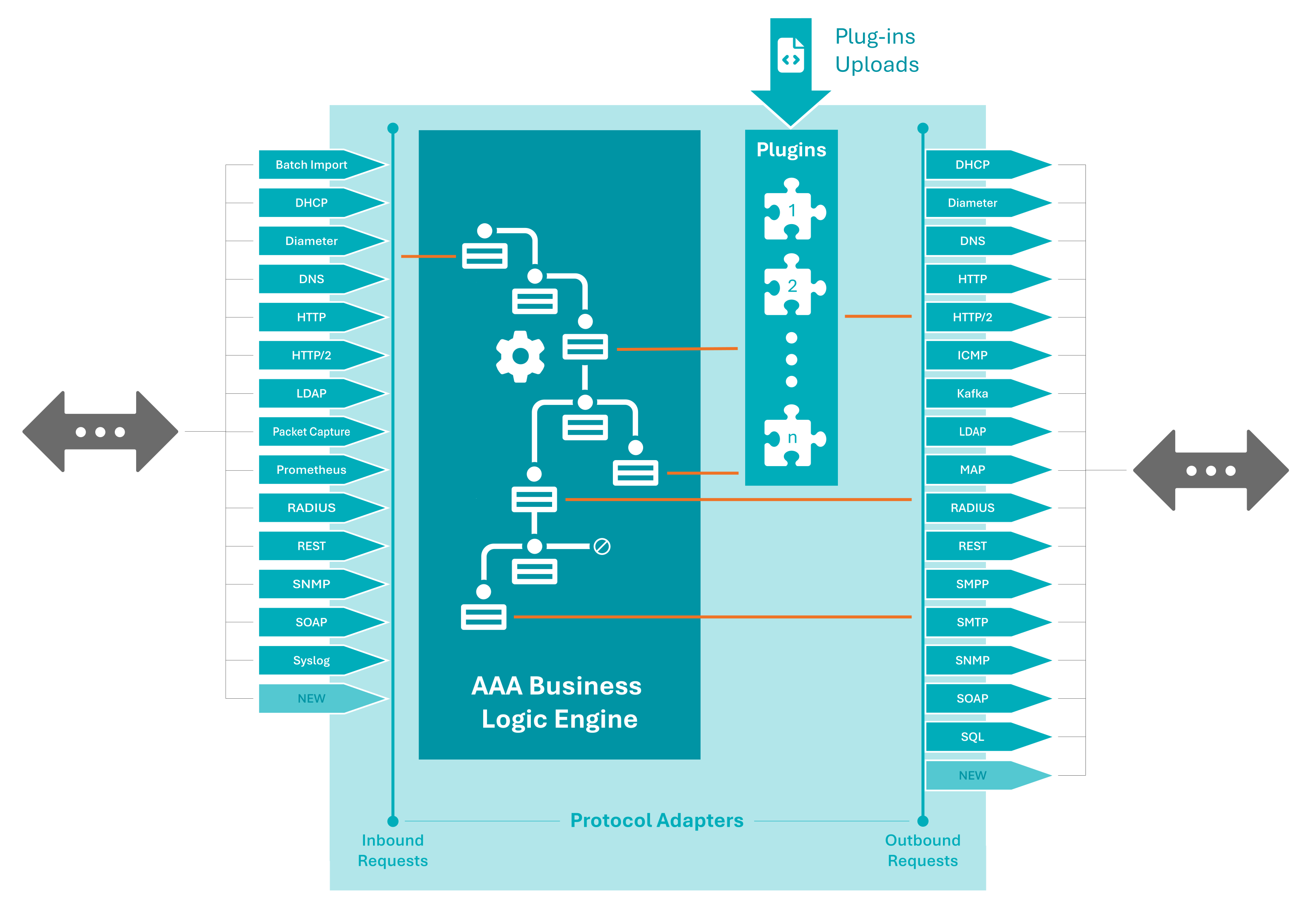
The ability to build business logic emulating existing AAA flows and logic is crucial for a smooth successful migration to the new AAA. After the migration this will also allow you to rapidly configure, customize, and extend the AAA’s functionality for innovation of new services.
The Requirement: Look for AAA that includes a powerful, granular business logic engine that can emulate existing AAA flows and allow definition of new complex service rules, featuring support for custom attributes, and integration with external policy definition and enforcement nodes. Open APIs and SDKs are vital for seamless integration with existing OSS/BSS, databases, and third-party applications.
An optimal AAA solution provides plug-ins for core network functions and critical integrations. Equally vital is robust lifecycle management for developing and deploying custom extensions. This modularity ensures agile feature introduction, eliminating dependencies on lengthy software release cycles.
The Benefits: This design allows for rapid, high-quality development, enabling new functionality to be delivered quickly and cost-effectively, and critically, logic from legacy AAA systems can be easily implemented. A next-generation AAA must enable operators to implement and maintain their own logic using scripting languages, and achieve 100% compatibility with existing external systems like AUSF/UDM/HSS/HLR, SQL Databases and LDAP directories.
Separation of Protocol and Business Logic
The Requirement: Legacy AAA systems may hard-code logic into the core software. This is a trap. Look for a solution with a microservice architecture that explicitly separates protocol implementation from business logic. Support for new protocols should be easily implemented by adding new protocol adapters.
The Benefits: This allows for rapid introduction of new use cases. You should be able to modify business rules via a logic engine without touching the core stack. This approach has proven vital in recent migrations where operators needed to replicate complex, custom logic from the legacy AAA without having to wait for new feature requests to be implemented.
Optional Integrated Databases and IP Allocation
To minimize latency and reduce architectural complexity, a modern AAA should offer more than just a AAA core and native business logic engine.
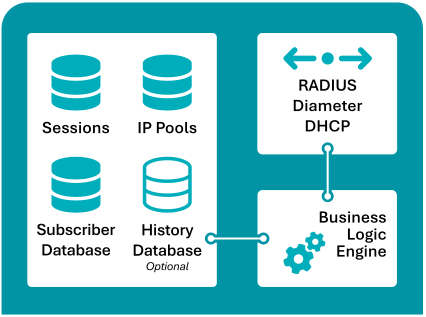 The Requirement: No AAA has better performance than its databases. Look for an AAA with high-performance session database and optional subscriber database, both purpose-built and optimized for the AAA use case. External database lookups from general purpose SQL databases can introduce latency that kills the user experience in highspeed networks. Additionally, it should feature an optional IP allocation function available via RADIUS or via a built-in DHCP server functionality. Managing IP address allocation via a separate, siloed DHCP server adds another point of failure and management overhead.
The Benefits: A superior AAA solution often includes an integrated, purpose-built session database as well as an optional subscriber database, both synchronizing data across geo-redundant sites without the performance penalty of generic SQL databases. This ensures real-time session management and charging accuracy even at peak loads and if a node becomes unavailable. AAA solutions that include carrier-grade DHCP functionality allow for tighter coupling between authentication and IP addressing. This enables smoother session setup, better address pool management (especially for IPv4/IPv6 dual-stack), and simplified troubleshooting and innovation since the AAA has full visibility into the IP assignment process. An optional History Database is also useful in many use cases.
True Cloud-Native Architecture (CNF) and Deployment Flexibility
“Virtualization”, putting software on a Virtual Machine (VM), is no longer enough for most telecom operators. The shift to cloud-native (CNF) principles with its microservices, containers, and Kubernetes orchestration offers unparalleled agility, resilience, and resource efficiency.
The Requirement: Evaluate AAA solutions that are truly cloud-native, enabling deployment across private cloud, public cloud, or hybrid environments. This facilitates automated deployment, scaling, and operational management, aligning with broader network virtualization strategies. The AAA should support all kinds of Kubernetes-based environments and be able to leverage related open-source Operations, Administration, and Management (OAM) tools. Furthermore, it should support automated updates and upgrades leveraging CI/CD pipelines and GitOps integration. It should include built‑in features that simplify migration to CNF, enabling incremental, low‑risk transitions, learn more in our next post Operational and Strategic Imperatives.
The Benefit: This enables auto-scaling and self-healing with a flawless migration to CNF.
5G and Converged Access Readiness
The Requirement: A modern AAA must be architected for the 5G era. This includes native support for 5G-specific interfaces and protocols such as HTTP/2, integration with network slicing for differentiated services, and the ability to handle converged access technologies (fixed, mobile, Wi-Fi, cable) under a unified framework. Solutions must provide a clear 3GPP roadmap and pragmatic, interoperable extensions for real-world gaps — for example, supporting SIM-based authentication in 5G Standalone when using local Wi‑Fi breakout. Well established use cases like Wi-Fi Calling (Voice over Wi-Fi) and Entitlement services (e.g., for Apple devices) should be supported out-of-the-box.
The Benefit: Readiness for next-generation services.
Integration Capabilities and Open Standards
The Requirement: No AAA operates in isolation. Its value is amplified by its ability to integrate seamlessly with various network elements, subscriber databases (e.g., HLR/HSS, UDM), charging systems, and operational support systems. Adherence to open standards (e.g., RADIUS, Diameter, HTTP/2, OAuth), pragmatic functionality to solve gaps between new standards and existing systems and comprehensive API documentation are critical for a future-proof, multi-vendor environment.
The Benefit: Smooth deployments in existing environments.
Protocol Agility and Convergence
The Requirement: The system must handle legacy and future simultaneously. It needs to act as a bridge—for example, acting as a RADIUS to Diameter SWm proxy with IMSI decryption, handle complex Diameter routing, or translate between non-standard legacy network elements and modern cores. It should be possible to add support for additional protocols without affecting the business logic or having to upgrade the entire system.
The Benefit: This agility significantly reduces total cost of ownership (TCO).
###
Download the full white paper below. You can also go here to learn more about the Enea AAA Server
A Strategic Guide to AAA Replacement
Legacy AAA systems are struggling to keep up with increasing data volumes, cloud-native architectures, rising complexity, and ever-increasing operational costs. This white paper gives CSPs practical insights on when and how to modernize their AAA infrastructure – delivering higher performance, greater flexibility, lower TCO, and a future-proof foundation for next-generation services.
Access

Why Intelligent AAA is the Swiss Army Knife of Telecom
The AAA server is no longer a static gatekeeper. It's now a Programmable Core capable of intelligent mediation, multi-generation interworking, and policy-driven orchestration at the network edge. Drawing on 8 Tier 1 operator case studies, this white paper shows how the Enea AAA Server turns operational complexity into scalable, revenue-generating services.
Access