CSP E – TIER 1 NORTH AMERICAN MOBILE OPERATOR
HTTP/2 to Diameter Protocol Conversion
CSP E, a leading North American Tier 1 mobile operator, utilizes the Enea AAA Server as an Interworking Function (IWF) to bridge the signaling gap between its 5G Standalone (SA) core and its legacy mediation infrastructure. The Enea IWF performs high-performance protocol conversion between 5G HTTP/2-based endpoints (N7 and N40) and the Diameter-based Gx and Gy interfaces required by the Hewlett Packard Internet Usage Manager (IUM).
Explore seven additional case studies by downloading the full Why Intellegent AAA is the Swiss Army Knife of Telecom paper below. You can also go here to learn more about the Enea AAA Server.


The 5G Protocol Mismatch: Legacy Systems in an HTTP/2 Core

While CSP E’s mobile core has evolved to support 5G SA, the operator continues to rely on the HP IUM to collect, aggregate, and normalize usage data for its billing systems. However, HP IUM reached End-of-Life (EoL) in 2021 and lacks support for the HTTP/2 RESTful protocols used by modern 5G Session Management Functions (SMF). This created a critical compatibility barrier between the legacy mediation layer and the next-generation core.
Enea AAA Server as an Intelligent Interworking Function

The Enea AAA Server serves as a versatile mediation and protocol conversion layer, leveraging its powerful business logic engine to facilitate signaling between the 5G Session Management Function (SMF) and the legacy HP IUM. In this 5G architecture, the Enea Interworking Function (IWF) operates as an HTTP/2 Server for the 5G core and a Diameter Client for the HP IUM. Simultaneously, the solution provides essential mediation for 4G services, rewriting signaling messages to ensure seamless compatibility between the 4G Packet Gateway (PGW) and the HP IUM infrastructure.
 Deployement
 Deployement
The Enea solution is deployed as a Cloud-Native Function (CNF) within a Kubernetes environment. To ensure high availability, the system is distributed across three regions, each featuring two geographically separate sites. Each site is dimensioned to handle the full traffic load for its respective region, providing robust local failover capabilities.
Key Technical Advantages
- Selective Protocol Support: The solution supports the specific subsets of N7 and N40 required by CSP E, performing 1:1 mapping between HTTP/2 JSON fields and Diameter Attribute-Value Pairs (AVPs).
- Logic Abstraction: The Business Logic Engine separates application logic from external interfaces. This allows CSP E to adapt to changing requirements or specific signaling behaviors via configuration updates, eliminating the need for core code patches or new product releases.

Mediation Examples
The flexibility of the Business Logic Engine allows CSP E to implement a wide range of custom signaling rules.
Representative examples of these specialized behaviors include:
- Suppression of CONTINUE Credit-Control-Failure-Handling: To support the PGW’s internal CONTINUE-RETAIN policy, the IWF suppresses any Credit-Control-Failure-Handling AVPs with a value of CONTINUE. By not sending this value in the reply, the IWF allows the PGW to execute its local policy, while all other values for this AVP are forwarded transparently.
- Service-Identifier Translation: Due to communication constraints between the SMF and HP IUM, the IWF translates 5G Service Identifiers into the specific Rating-Group/Service-Identifier pairs required by IUM.
- Zero-Usage Filtering: To prevent downstream processing errors in the legacy IUM, the IWF filters out 5G usage updates with a total volume of zero before they are proxied.
- Context Management and Attribute Injection:
- AF-Charging-ID Management: The IWF stores the AF-Charging-Identifier received via Gx and injects it into subsequent Gy messages to satisfy HP IUM’s requirements for session continuity.
- Access-Network-Charging-Identifier Injection: Since the SMF does not transmit the Access-Network-Charging-Identifier, the IWF stores this value and inserts it into outgoing CCR-T (Terminate) messages to ensure the IUM receives a complete session record.
- Synchronized Session Closure: To maintain data integrity, the IWF ensures that the N7 policy session remains open until the corresponding N40 charging session is closed, ensuring that critical context from the policy layer is available for final charging updates.
- Bitrate Normalization: The IWF ensures bitrate values are delivered to the SMF in a consistent “bps” format, preventing issues with prefix conversion (e.g., ensuring “1024 bps” is sent instead of “1 kbps”).
- Result Code Mapping: The IWF maps Diameter result codes (e.g., DIAMETER_SUCCESS) to appropriate HTTP status codes (e.g., 201 Created) to ensure the 5G core receives standard RESTful responses. Errors are mapped to corresponding HTTP status codes (4xx/5xx errors).
- Bitrate AVP and value adjustment: The IWF maps Max-Requested-Bandwidth-UL/DL from the HP IUM to the APN-Aggregate-Max-Bitrate-UL/DL format required by the PGW. It also adjusts special values (e.g., 0/0) to concrete, PGW-supported bitrates to ensure consistent QoS enforcement.
- Gx update triggering: IWF can trigger Gx Re-Auth-Requests (RARs) and thus request for Gx Update based on Gy traffic. This allows for faster updates to the session limits (e.g., bandwidth), based on Gy RARs and/or responses as they arrive from HP IUM.
High-Level Message Flows: Protocol Conversion

Request Flow (HTTP/2 to Diameter):
- The Enea IWF receives an HTTP/2 signaling message from the SMF (A).
- The business logic engine translates JSON fields into appropriate Diameter AVPs and initiates a Credit-Control-Request (CCR) toward the HP IUM (B).
- Upon receiving a Credit-Control-Answer (CCA) from the IUM, the IWF maps the AVPs back to JSON fields and returns the appropriate HTTP status code to the SMF.
Note: If there’s a field that cannot be translated 1:1, the same will be omitted from the outgoing diameter message.
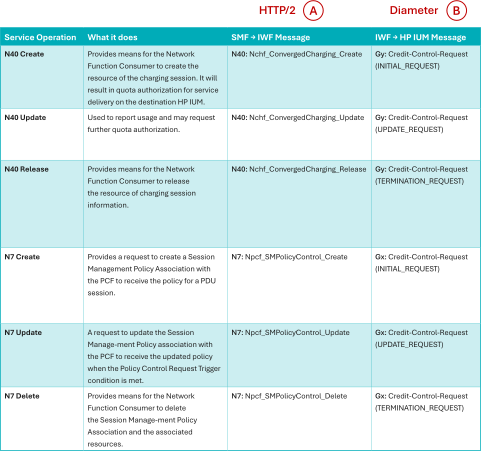
In the following section, we delve into the critical protocol conversions performed by the Enea IWF. This process involves transforming incoming HTTP/2 signaling (A) from the SMF into the Diameter signaling (B) required by the HP IUM.
Protocol Conversion Details
Below table shows the most important conversions that are made by Enea IWF:
Re-Auth-Request (RAR) and Notification Flow

When the HP IUM initiates a Re-Auth-Request (RAR) over Diameter, the Enea IWF triggers a separate notification flow to the SMF:
- Charging Notifications: A N40 Notify Service Operation (Nchf_ConvergedCharging_Notify) is sent to the SMF to communicate subscribed events.
- Policy Notifications: A N7 Update/Notify Service Operation (Npcf_SMPolicyControl_UpdateNotify) is triggered to update or delete PCC (Policy and Charging Control) rules and PDU session-related policy context.
Once the notification is sent out to the SMF from Enea IWF, the expectation is that this will trigger an update or release operation on SMF. This will be processed as the completely separate call flow described above.
Note: If AVPs in the Re-Auth-Request are not sufficient to create the Notify request, the same will be omitted.
A Strategic Guide to AAA Replacement
Legacy AAA systems are struggling to keep up with increasing data volumes, cloud-native architectures, rising complexity, and ever-increasing operational costs. This white paper gives CSPs practical insights on when and how to modernize their AAA infrastructure – delivering higher performance, greater flexibility, lower TCO, and a future-proof foundation for next-generation services.
Access
Why Intelligent AAA is the Swiss Army Knife of Telecom
The AAA server is no longer a static gatekeeper. It's now a Programmable Core capable of intelligent mediation, multi-generation interworking, and policy-driven orchestration at the network edge. Drawing on 8 Tier 1 operator case studies, this white paper shows how the Enea AAA Server turns operational complexity into scalable, revenue-generating services.
Access