
Stratum Network Data Layer for scalable 4G and 5G networks

Stratum Network Data Layer

Unified storage and distribution of user and session data to power critical telecom services

Scalable Cloud-Native Data Layer for Business and Mission Critical Core Network Applications

In modern networks, every service starts with a user and a session. These user and session data drive both mission-critical and business-critical services across the network, from initial UE attach authorization, real-time policy control, charging, fixed network AAA, to CRM systems, self-care portals and billing platforms. Every one of these functions depends on a consistent, accurate and always up-to-date view of the subscriber, device, subscription and session state.

But in most environments, that data is scattered across legacy systems, value-added services, OSS/BSS stacks and multiple generations of core network functions. When that context is fragmented or stale, service quality degrades, troubleshooting slows, and innovation across all layers of the network is constrained. The result? Slow change, high cost, and complex integrations each time you launch a new service or modernize a part of the network.

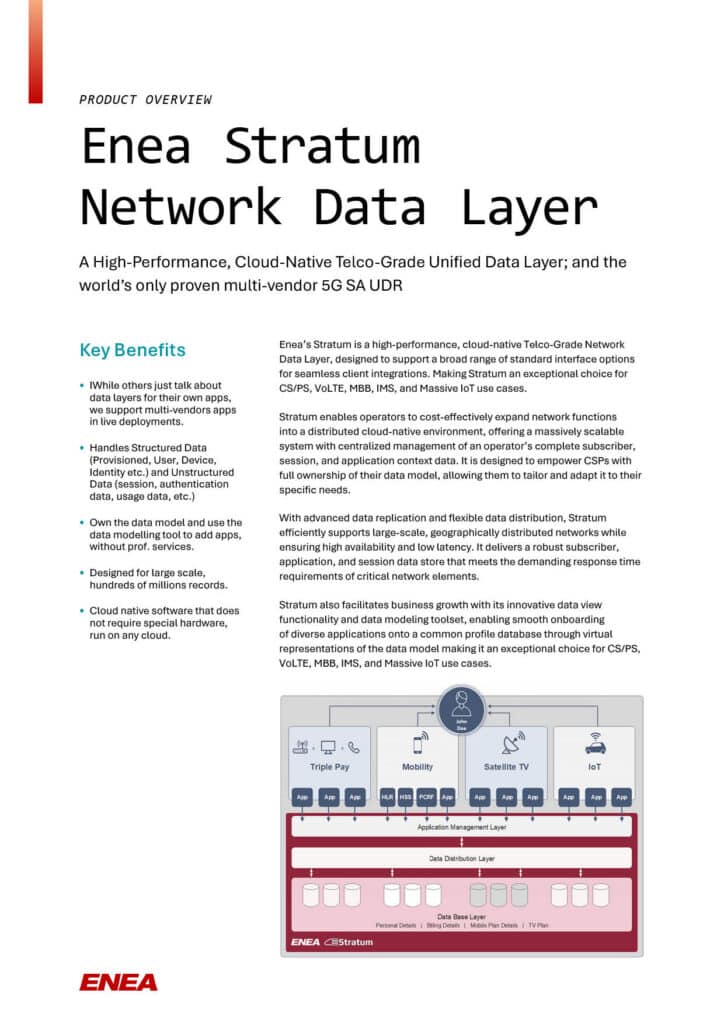
Enea Stratum provides a unified, cloud-native in-memory distributed database architected to meet carrier grade robustness and Telco performance demands. Built with an open design suitable for cross domain use, enabling and end to end optimized database lifecycle management. Instead of building bespoke data silos for every application, Stratum gives you a single shared data backbone designed for mission- and business-critical workloads over multiple domains like fixed access, 4G/5G mobile core, Wi-Fi, and FWA.

Operator Challenges: Fragmented Data & Slowed Innovation

Communication providers and other verticals face a similar pattern:

  • User and session data duplicated across many legacy platforms
  • Tight coupling between applications and their proprietary databases
  • Complex synchronization and data consistency issues
  • Costly migrations when modernizing network functions or moving to cloud
  • Risk of vendor lock-in and limited flexibility in how data can be modelled and used

At the same time, expectations are rising, with demands for ultra-reliable connectivity, real-time personalization, and rapid introduction of new digital services — all across converged fixed and mobile cores and partner ecosystems.

Challanges for telecom operators regarding session and user data

Solution: Unified, Cloud-Native Data Layer at Your Own Pace

Stratum is a distributed, telco-grade database cluster purpose-built for subscriber, and session data in telecom networks. It acts as a common data layer for:

  • Core network mission-critical functions
  • Business-critical applications and value-added services
  • IT/OSS/BSS systems needing real-time, authoritative user and session context

On the journey toward a single source of truth for user- and session-centric information, Stratum lets operators move at their own pace. Instead of touching the most mission-critical subscriber data management (SDM) systems first, you can start by consolidating databases for business-critical and value-added applications – such as portals, CRM, analytics, marketing and OSS/BSS functions.

Stratum seamlessly coexists with standards-based SDM/UDR deployments, creating an open, cloud-native data layer for all non-SDM use cases. As confidence grows, you can expand the footprint step by step, aligning with your own application roadmap and network transformation strategy, while continuously retiring silos and reducing complexity.

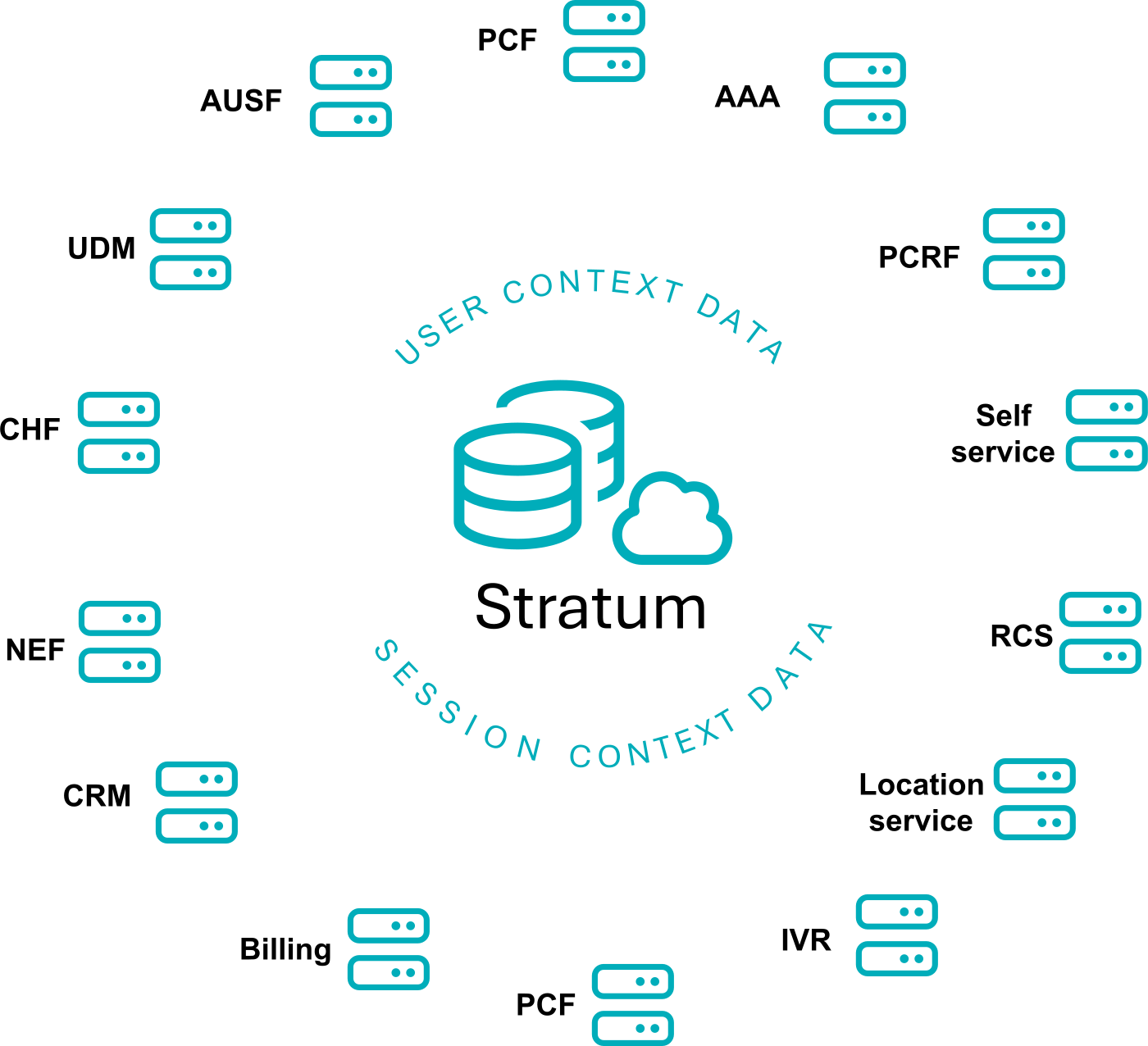
Stratum unified user and session data

Stratum: The Foundation for Your Next-generation Data Strategy

As telecom networks converge and cloud-native architectures become the norm, a high-performance, open, multi-vendor-ready database for unified user and session data is no longer optional — it’s a strategic necessity. Enea Stratum gives communication providers and digital service innovators a robust, future-proof network data layer: one platform to power mission-critical core functions, business-critical applications, and the next wave of differentiated services.

Stratum for Demanding, Multi Access Networks

Built for Demanding, Multi-Access Telecom Networks

Whether serving mobile core NFs, fixed broadband gateways, AAA, or enterprise/vertical applications, Stratum delivers predictable performance and reliability with an architecture designed for large-scale, distributed telecom environments:

  • Cloud-native design with optimal portability – runs on any Kubernetes environment, in public or private clouds or on-premises, with no special hardware requirements.
  • Distributed and resilient – advanced data replication and conflict resolution keep data consistent and available close to where it’s used, even across geographies and sites.
  • Telco-grade performance at large scale – proven for >1 million TPS with millisecond-level latency at nationwide scale, supporting five-nines availability for critical services. Scalable to 100s of millions of user and session data documents

Stratum with Open, Multi Vendor and Operator Controlled Data Model

Open, Multi-Vendor and Operator-Controlled Data Model

Stratum is designed to fit into multi-vendor environments, not lock you into one. It supports industry-standard interfaces and offers a flexible, open data model so operators, not vendors, own how data is structured and accessed.

This enables you to:

  • Onboard new network functions and applications faster
  • Replace or evolve vendors without re-architecting the data layer
  • Extend the same user/session data to IT, analytics and AI/ML platforms
  • Avoid expensive professional services every time a data model change is needed

Tangible Benefits for Network Optimization and Modernization

Stratum, our cloud-native distributed database built for telco demands, enables the introduction of an unified user and session data platform for operators and enterprises. This is helping our customers to:

Monetization

Reduce TCO

  • Eliminate parallel databases and complex data synchronization
  • Simplify operations and lifecycle management with one shared platform
Accelerate speed

Accelerate Time-to-Market

  • Reuse the same trusted data for new services and channels
  • Decouple application innovation from backend re-plumbing
  • Accelerate onboarding of new applications and partners
monetize and save costs

Optimize Investments and Future-Proof the Network

  •  Scale capacity with demand instead of over-provisioning per silo
  • Support stepwise migration from legacy to cloud-native architecture
  • Enable stateless applications for higher availability and lower cost
Security

Strengthen Security and Compliance

  • Centralize control of access, encryption and audit across all user/session data

Proven Results Among Our Telecom Customers

Stratum is the result of two decades of experience delivering ultra-reliable data solutions to Tier-1 operators. With Stratum, mobile network operators are transforming how they manage subscriber and session data:

  • US Tier-1: ~20 mission-critical applications for 120 million subscribers
  • EMEA Tier-1: ~36 business-critical applications for 30 million subscribers
  • EMEA Tier-1: Universal repository supporting 11 network application vendors for rapid slice deployment
  • Enea’s expertise, quick install, and proven ability to scale its solutions, made them the obvious choice

  • Stratum SDM overcomes the shortcomings typical of the current, largely hardware-based radio networks that operate in vertical silos

  • Enea has established a standard that other Subscriber Data Management platforms should be challenged to meet

  • Enea’s story should resonate well with operators that are moving aggressively forward with big-data initiatives

Specifications and Standards Compliance

Stratum complies with leading industry standards, including:

3GPP: 23.335, 23.501, 23.845, 29.335, 29.500, 29.504, 29.505, 29.519, 29.571, 29.808, 29.935, 32.181, 32.182

IETF: LDAP (RFC 4511–4519, 4522, 4523), REST/JSON (RFC 7540, 8259), DIAMETER (RFC 6733)

Subscriber Data Management in 5G

Keith Dyer of The Mobile Network and Fergus Wills, Enea, on the impact of 5G on service delivery through subscriber data management.

Stratum Ends Vendor Lock-in

A 5G network data layer that solves the problem of vendor lock-in. It’s time to liberate your data – with Stratum!

Contact Our Telecom Experts

Future-Proof Your Network Data

Stratum isn’t just a data store—it’s the foundation for modern, dynamic, vendor-neutral telecom environments. By centralizing data and decoupling it from the control plane and applications, Stratum simplifies operations, enables innovation, and prepares your network for what’s next.

Would you like to know what Stratum can accomplish in your network? Schedule a meeting with our experts.

Frequently Asked Questions

What does “Network Data Layer” and “Unified User and Session Data Layer ” mean in a telecom network?

It refers to combining all subscriber-, device-, policy-, and session-related context data into a single logical data layer. This eliminates the fragmentation that happens when network functions (like HLR/HSS, PCRF, AAA, and NMP) and business critical and value added service applications (like IVR, RCS, CRM, User Locations, Billing, and Self-Service Portals) each store their own copies of the same information.

Why is unifying subscriber and session data important for operators networks?

Because it removes duplicated data, reduces provisioning complexity, allows stateless network functions, and ensures all services use the same consistent data view. This is essential for 5G service-based architecture (SBA), network slicing, IoT scale, and hybrid-cloud deployments.

How does a unified data layer reduce OPEX for mobile operators?

Operators avoid:
• Multiple and complex provisioning flows and systems
• Custom integrations for each vendor database and complicated database lifecycle
• duplicated user context data storage and complex data consistency and data integrity and consistency
• per-application data replication and heterogeneous resiliency policies. A single data layer dramatically cuts integration, testing, and lifecycle-management costs.

How does Stratum unify structured and unstructured data?

Stratum combines IETF LDAP user context data repositories, 3GPP-compliant UDR and SPR (for subscriber/session data) and UDSF (for application specific/state data) in one consistent architecture. Operators manage all data types through the same platform, API framework, security controls, and replication strategy — while still respecting 3GPP boundaries.

What problems does a unified data layer solve better than traditional monolithic applications architectures?

• Eliminates siloed subscriber data
• Avoids proprietary vendor databases
• Supports stateless NFs for horizontal scaling
• Simplifies 4G–5G coexistence
• Reduces vendor lock-in
• Enables seamless hybrid-cloud and edge deployments

How does unified data help with multi-vendor 5G deployments?

Each NF can access the same canonical data through 3GPP-standard interfaces rather than maintaining its own database. This prevents vendor-specific data models and enables operators to introduce new NFs without per NF custom database integrations.

What is Subscriber Data Management (SDM)?

Subscriber Data Management (SDM) is the standardized function in mobile networks that manages subscriber identities, profiles, and service entitlements across technologies (incl. 3GPP-defined UDC/UDR). As networks evolve, the critical shift is to decouple application and business logic from the underlying data backend. Consolidating subscriber and network context for reuse this information across multiple network applications lets operators simplify overall network operations and database lifecycle management, and innovate faster.

What is CAP and PACELC, and what does it imply for telcos?

The CAP theorem states that distributed databases must trade off Consistency, Availability, and Partition tolerance. PACELC extends this by adding a Latency–Consistency trade-off even when there is no partition. In today’s networks, distributed systems must assume partitions will occur. For operators running core, BSS/OSS, and other mission-critical services, Stratum scalable multi-active database design includes native replications incorporating consistency and conflict-resolution mechanisms to deliver always-on services without unpredictable performance.

What does MELT imply for telecom operators?

MELT stands for Metrics, Events, Logs and Traces – the core telemetry operators need to run carrier-grade, distributed databases and value-added services with confidence. Meaning a modern operation support of end-to-end observability across clusters, networks and applications, not just node health. Fueling Grafana with our cloud-native stacks for metrics, logging, and events, operators gain faster incident detection, simpler root-cause analysis and service levels monitoring for business- and mission-critical workloads.

What does GitOps imply for telecom operators?

GitOps is an operating model where your Git repository becomes the single source of truth for deploying and managing infrastructure and applications. For operators, this means declarative configs, where changes are versioned, auditable, and rollbacks are simple. This reduces manual error, speeds up SW roll-out, and makes operating critical database clusters more predictable and secure.

What is Anti entropy and what does it benefit telecom operators?

Anti-entropy is a background process in distributed databases that continuously compare replicas to detect and correct inconsistencies over time. In Stratum, our cloud-native, carrier-grade platform, anti-entropy works hand in hand with our scalable replication solutions, native data repair, and advanced conflict resolution to automatically heal data drift across regions and sites. For operators, this means fewer manual interventions, faster recovery from node or link issues, consistent subscriber data across sites, and more predictable SLAs for mission- and business-critical services.

What is Network function virtualization (NFV)?

Network function virtualization (NFV) is a SW deployment architecture that replaces fixed, hardware-based network appliances with software-based virtual network functions (VNFs) running on standard servers. NFV made networks more flexible and cost-efficient by allowing operators to spin up, scale, and retire functions in software. Today, the industry is evolving further toward containerized network functions (CNFs), architected as cloud-native, lighter-weight micro service software applications, normally orchestrated by infrastructure platforms like Kubernetes (K8S). CNFs align better with today’s Telco’s services needs of scale, distribution, resilience, and operation efficiencies.