Stratum Network Data Layer
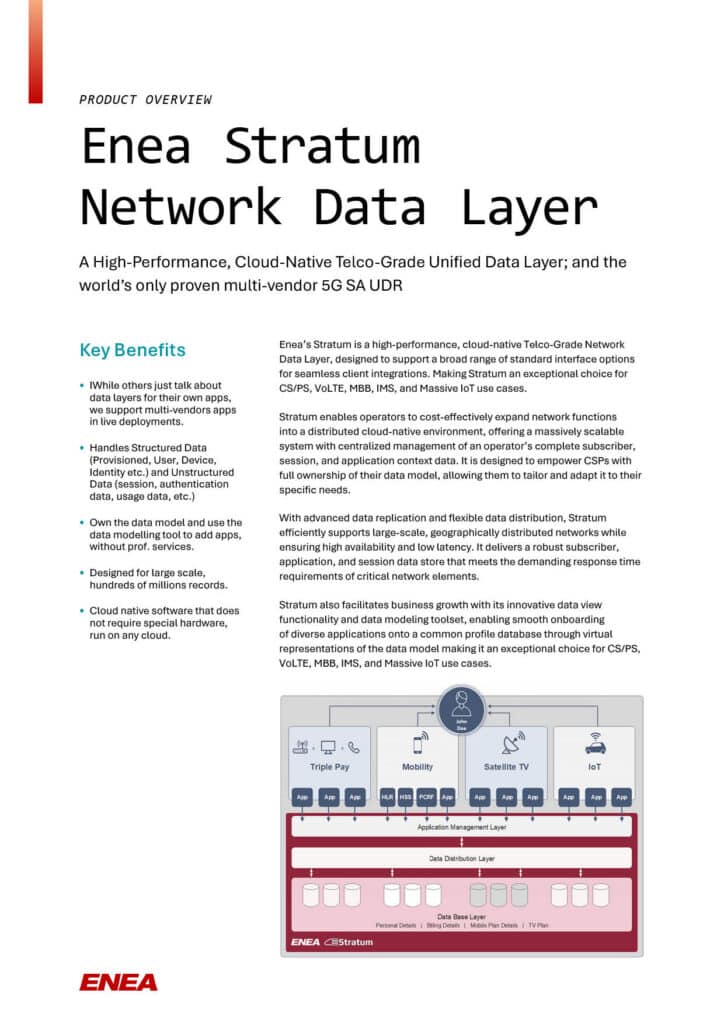
Stratum Network Data Layer is the perfect cloud-native, resilient storage and distribution layer to reduce the complexity of each application storing their own data their own way!
Open
As you move to 5G Standalone (SA), the pressure is on: launch new services faster, monetize slices and APIs, and guarantee SLAs across consumer, enterprise, and industrial use cases. To deliver all that, your 5G core must be agile, scalable, and stateless — with a robust way to store and share data across every network function.
That’s where our Stratum as a 5G SA UDSF comes in.
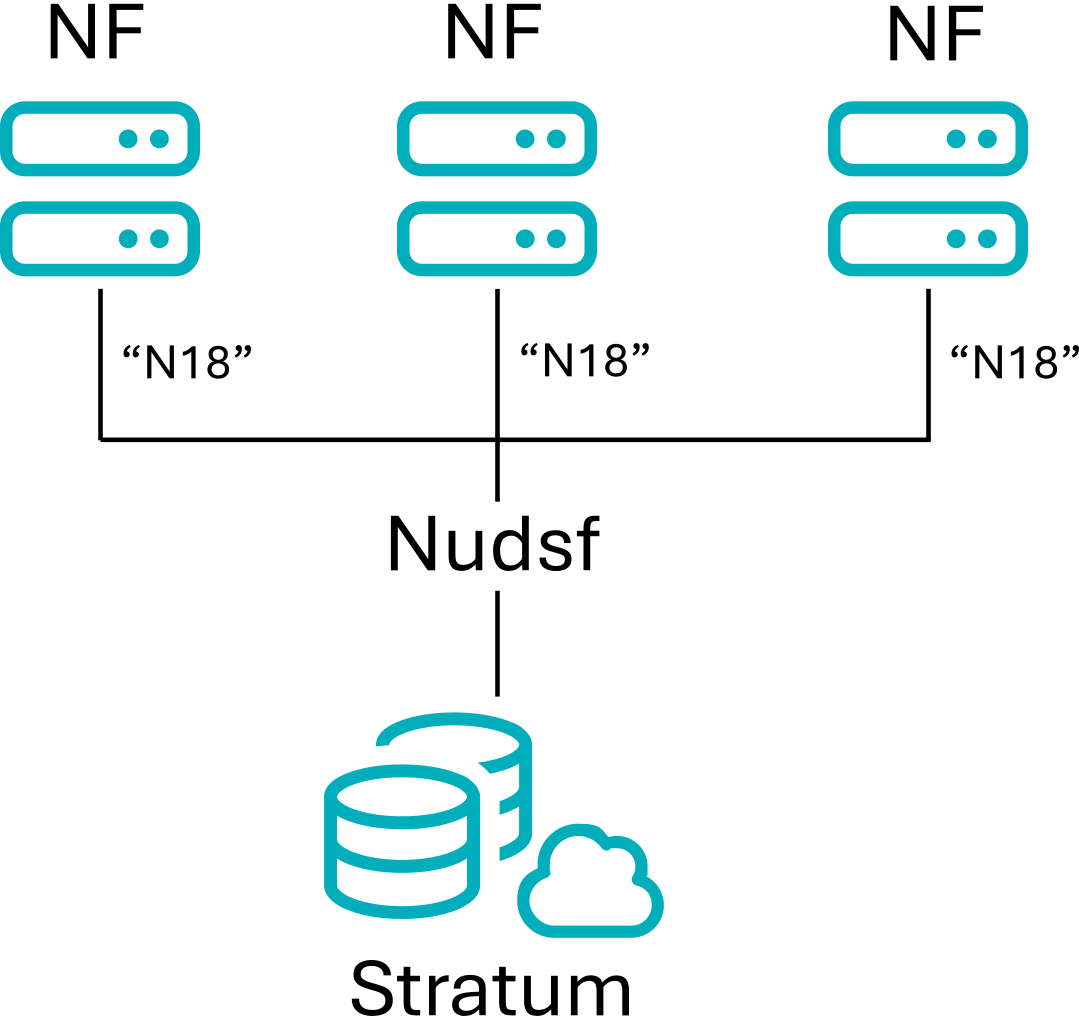
Stratum, our cloud-native UDSF, is a 3GPP-compliant data storage function that decouples state from your 5G core network functions. Instead of each NF managing its own database, they can offload their unstructured information — such as authentication vectors, session usage and consumption data, IP–device associations, and application state — to a shared, highly available data layer, simplifying your architecture and unlocking true cloud-native elasticity.
The Stratum UDSF provides a common, low-latency unstructured information storage platform for 5G SA and business support functions such as UDM/AUSF, SMF, AMF, PCF, CHF, and application servers. It enables:
By harmonizing unstructured data storage, operators can:
With the Stratum 5G SA UDSF, your data layer becomes a strategic enabler — helping you build a simpler, more flexible 5G SA and business support operations core that’s ready for whatever comes next.
Stratum isn’t just a data store—it’s the foundation for modern, dynamic, vendor-neutral telecom environments. By centralizing data and decoupling it from the control plane and applications, Stratum simplifies operations, enables innovation, and prepares your network for what’s next.
Would you like to know what Stratum can accomplish in your network? Schedule a meeting with our experts.
UDSF stands for “Unstructured Session Data Storage Function.” It is a 3GPP-defined storage function (according to release-specifications such as 3GPP 29.598) for handling unstructured or semi-structured data in 4G/5G networks — for example session state, dynamic authentication vectors, usage/consumption data, IP-device mappings, and other data that does not fit strict subscriber- or device-data schemas.
In cloud-native, disaggregated 5G networks, many network functions (NFs) and applications generate dynamic runtime data (session context, usage, state) that needs to be shared across multiple components. Instead of each NF storing its own state (leading to silos, complexity, and vendor lock-in), UDSF allows a common, standardized storage and retrieval mechanism — helping realize stateless NFs, enable horizontal scaling, and simplify data sharing and reuse across functions.
UDSF is meant for dynamic/unstructured session or state data: e.g. session context, authentication vectors, IP–device association, usage/consumption counters, ephemeral metadata. In contrast, structured data — like subscriber identity, device identity, user profiles, policy data — belong in a structured repository such as the UDR/SPR (Unified Data Repository / Subscriber Profile Repository).
When leveraging UDSF via Stratum Network Data Layer, mobile operators get several benefits:
• Stateless network functions: NFs don’t carry state internally — state is offloaded to Stratum/UDSF — simplifying scaling, failover, upgrades, redundancy.
• Unified data layer for all data types: Both unstructured (session/state) data and structured (subscriber, device, policy) data are managed in one common layer — reducing data silos, duplication, and operational fragmentation.
• High performance and reliability: Stratum is built for telecom-grade demands, offering hybrid storage (in-memory or disk), configurable durability, and distributed deployment — enabling data access with low latency even in multi-site, cloud-native or hybrid-cloud setups.
• Flexible replication and deployment (core/edge/hybrid): Operators can choose how and where data is stored or replicated, whether synchronous or eventual, enabling support for distributed environments, private 5G, edge computing, and IoT.
• Vendor-neutral, open architecture: Because Stratum is designed for open flexible data modelling and implements standard interfaces, operators avoid vendor lock-in and can integrate heterogeneous network functions from different vendors.
Stratum supports both structured data and unstructured data, and the structured data layer and unstructured data layer can coexist but remain logically distinct. This separation ensures that structured data remains clean, consistent, and stable, while dynamic session data is handled separately, avoiding schema pollution and ensuring clarity.