


Overview
Explore

Network Data Layer
Stratum, a Scalable Cloud-Native Data Layer for Business and Mission Critical Core Network Applications
4G still carries the bulk of traffic and revenue – and a huge estate of business-critical and value-added services depends on it. From fixed access and broadband AAA to IMS and messaging, PCRF/SPR policy control, charging, customer care, and partner VAS platforms, every application needs consistent, real-time access to subscriber and session data.
In practice, this information is typically scattered across LDAP directories, 3GPP UDC/UDR systems, SPR databases, and custom application stores. Each new service means yet another integration with Ud, Sh, or proprietary interfaces. Fragmented data slows rollouts, complicates troubleshooting, and increases costs every time you modernize or move to cloud.
Stratum, our unified user and session data layer, is a cloud-native database specially designed to provide a telco-grade data platform for 4G user and session context. Instead of each application owning its own silo, Stratum becomes a shared data backbone for:
Deployed as a distributed, Kubernetes-based cluster, Stratum lets you begin where the impact is highest: consolidating databases for business-critical and VAS platforms while co-existing with existing HSS/UDC deployments. As confidence grows, you can gradually onboard more applications—retiring silos, simplifying synchronization, and standardizing how user context is accessed across domains.
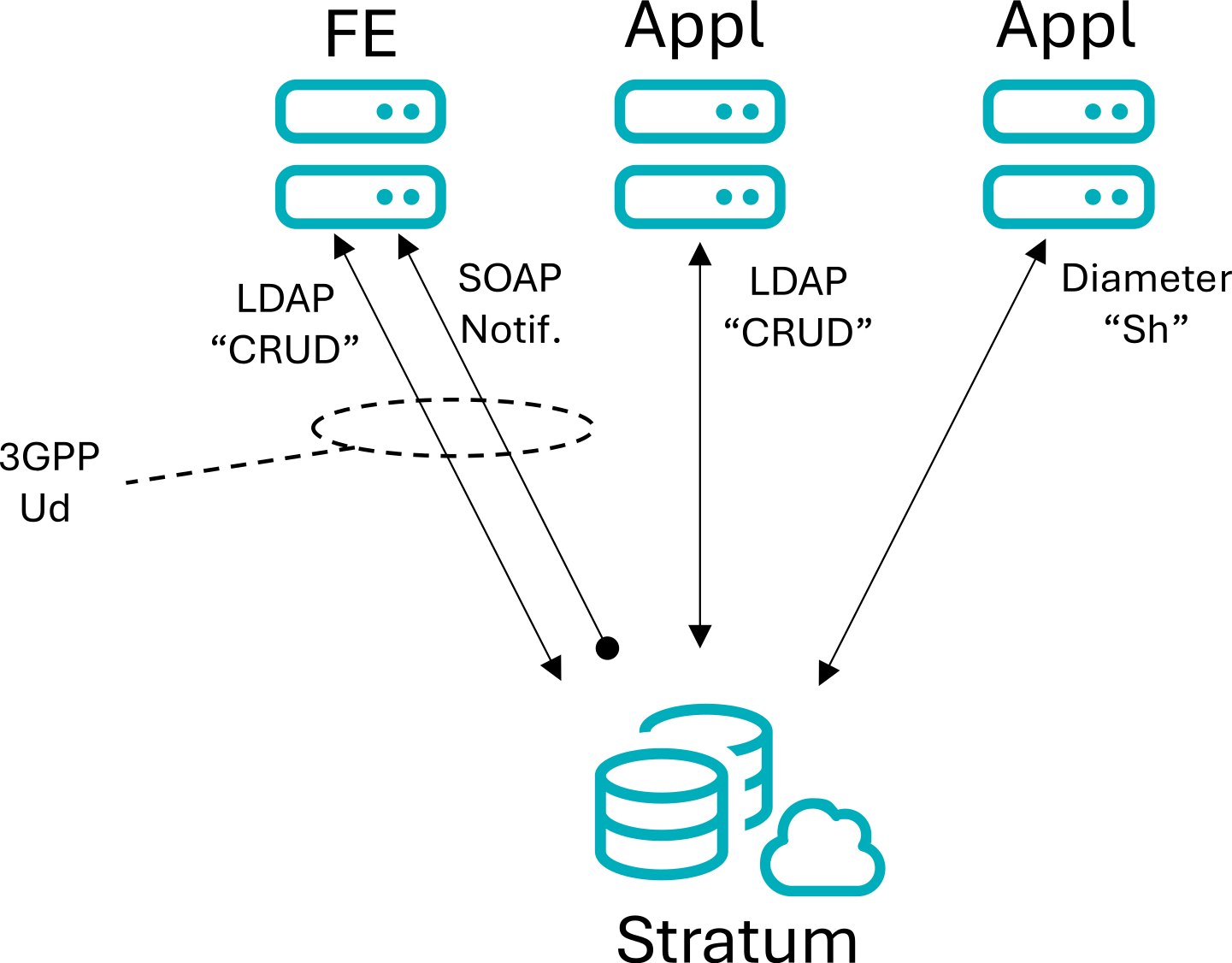
With Stratum as your unified user and session data platform, you turn legacy complexity into a strategic asset – powering business-critical and value-added services with consistent, real-time context.

Stratum isn’t just a data store—it’s the foundation for modern, dynamic, vendor-neutral telecom environments. By centralizing data and decoupling it from the control plane and applications, Stratum simplifies operations, enables innovation, and prepares your network for what’s next.
Would you like to know what Stratum can accomplish in your network? Schedule a meeting with our experts.
Operators avoid:
• multiple provisioning systems
• custom integrations for each vendor
• duplicated storage across each NF
• per-application data replication
A single data layer dramatically cuts integration, testing, and lifecycle-management costs.
Integrating Stratum brings several advantages:
• Centralized subscriber & device data — A single source of truth for subscriber identity, subscription, policy, device associations. This avoids fragmented data across multiple siloes or NFs.
• Cloud-native and hybrid-cloud readiness — Stratum supports distributed, cloud-native deployments, enabling operators to host subscriber data in core, edge, or hybrid environments, matching modern network architectures.
• Reduced data duplication & simpler provisioning — Instead of provisioning equivalent data across multiple systems (HSS, HLR, PCRF, IMS, etc.), all subscriber and device data is consolidated. This lowers operational overhead, reduces risk of inconsistencies, and simplifies lifecycle management (provisioning, update, deletion).
• Support for multi-vendor, multi-domain networks — Because Stratum implements standard 3GPP interfaces and data models, operators can integrate NFs from different vendors without worrying about proprietary subscriber-data schemas. This encourages vendor neutrality and smoother interoperability.
• Scalability, reliability and performance — A dedicated, optimized repository like Stratum’s UDR/SPR enables high throughput and low latency for subscriber data access, making it suitable even for large-scale networks with many subscribers and devices — including massive IoT.
Yes, Stratum have a flexible data model and multiple interfaces e.g. standard LDAP CRUD. Allow operators to integrate wide range of applications from different network domain for accessing user context data from Stratum with superior availability at large scale.
UDR stands for Unified Data Repository (in both the 3GPP UDC (2G/3G/4G) and 3GPP 5G SA architectures) and SPR stands for Subscriber Profile Repository (common in 4G/LTE). Both represent structured data stores holding subscriber- and device-related information: identity, subscription details, policies, device associations, profile data, authentication credentials, service entitlements, quotas, and more.
In modern telecom networks, many network functions (NFs) and applications need consistent, reliable access to subscriber and device data. Having a centralized repository like UDR/SPR ensures that all such functions get the same up-to-date view of user and device information — identity, subscription status, policies, entitlements — avoiding inconsistent or duplicated data across silos. It also simplifies management and provisioning: when a subscriber is activated, modified or deactivated, changes are maintained in one place and propagated to all relevant services.
Yes, UDR is standardized by 3GPP for 2G/3G/4G/5G NSA (see e.g. TS 23.335) and 5G SA, replacing older monolithic architecture with dedicated repositories, like for legacy HSS/HLR/SPR replaced in a converged “User Data Convergence” (UDC) architecture with business logic and data store separation.
Stratum is design for a flexible data modelling, allowing operators to own their model. Typically covering data such as:
• Subscriber identity — e.g. subscriber identifiers (IMSI, MSISDN), account IDs.
• Subscription profiles — service plans, entitlements, policy data, QoS, valid services, allowances.
• Authentication data and credentials used by other network functions for access control.
• Device & user-device associations and related metadata (e.g. provisioned devices, device capabilities). This helps manage which devices are allowed for a given user subscription.
• Quota, policy data, charging/policy control data (when used with Packet Core / Policy & Charging systems).
In other words — can cover all data critical for subscription and session management an structured use by multiple service domain within a operators’ network.
User Data Convergence (UDC) is a 3GPP architecture concept that centralizes subscriber data into a unified repository, decoupling service logic from the data layer. In this architecture, service logic applications are referred to as Front Ends (FEs) and the data layer as the Back End (BE). In the context of SDM, functions like HLR and HSS use a BE specified as the UDR (User Data Repository), while policy control functions such as PCRF use an SPR (Subscription Profile Repository) as their BE.
LDAP CRUD refers to performing Create, Read, Update and Delete operations on data stored in an LDAP (Lightweight Directory Access Protocol) directory. In Telecom networks, LDAP is used in multiple domains and in specifically the 2G/3G/4G/5GNSA network core service it applies as standard interface for access of subscriber, device, and service profile context data.