The secret to unlocking USD 29.4 billion in SMS revenue
Value-based pricing for A2P SMS, part 2: there is no added value without insights
In the previous article of this two-part series, we explained why operators should adopt value-based pricing for A2P SMS to maximize revenue and unlock USD 29.4 billion over five years. In this part, we will cover how operators can implement value-based pricing.
What is needed?
We concluded in the previous part that segmenting A2P SMS into critical and non-critical messages is a logical and acceptable basis for differentiating prices. The key capability operators need to do this is the ability to identify which messages are critical and which ones are not.
But how do we determine if a message is time-sensitive or critical for the business? One approach is to let brands decide whether to use a higher-priced priority connection or a lower-cost best-effort connection. However, this opens the door for less scrupulous aggregators along the delivery chain to boost margins by altering message priorities.
To prevent fraud, operators must control how messages are priced and enforce adherence to those prices. This requires pricing that is transparent and predictable for brands and aggregators with clear criteria.
Criticality alone is not a reliable criterion because different brands and aggregators interpret it differently and it is hard to evaluate. Instead, a more objective set of criteria should be used, such as the type of message. Traffic can then be classified into categories like promotions, authentication, and notifications. These categories are strongly correlated to criticality and are already well understood by both brands and the industry. Some messaging apps, including WhatsApp, also categorize business messages similarly, indicating that this is a good approach.
How then do we apply value-based pricing to these A2P SMS categories? The following is a rough suggestion for how we might set differentiated prices:
- Authentication messages like one-time passwords, verification codes, and password reset messages are considered critical and well-suited for SMS. Therefore, they should be priced higher.
- Notifications generally work well with SMS and can be important, but they aren’t always critical. We can categorize notifications into groups like confirmations, reminders, and delivery alerts. Among these, reminders are the most critical because they help reduce no-shows, which directly affect revenue, and other channels are less suitable for this type.
- Promotion messages are less time-sensitive but may still be tied to revenue. Brands often use a multichannel approach for promotions, leveraging channels that support richer content. This can reduce the added value of SMS, indicating it should be priced lower.
This is just an outline of how a smart pricing strategy for A2P SMS could function. Each mobile operator must determine the best segmentation and pricing strategy based on local conditions and the traffic mix terminating in their networks.
How can value-based pricing be implemented practically?
Once we decide how to categorize messages, the next step is to determine how to identify traffic as belonging to a specific category for accurate billing. There are two main approaches for this.
In the first case, operators use insights to bill aggregators correctly. They do not need to change any configurations for their A2P connections, except to categorize the traffic, which is done after it arrives in the network. Aggregators or service providers with direct connections to the operator do not need to modify their connections. The only change is that the operator uses categorization insights to bill termination fees based on differentiated pricing. For aggregators and service providers with direct connections to the operator, this remains the most straightforward method.
In the second case, the operator changes how aggregators connect, for example, by splitting traffic across different connections or by including category declarations to APIs exposed to aggregators. Here, message categorization is necessary to ensure proper pricing, preventing critical messages from being sent at a lower rate. This approach demands more from aggregators, who need to update their connections, but also offers greater transparency into how traffic is billed.
AI-driven categorization in messaging firewalls provides insights
In both cases mentioned above, messages need to be screened to understand their intent. A messaging firewall can offer such insights. In fact, messaging firewalls already provide insights into messages, mainly to detect spam and non-compliant content.
Interpreting messages is a task well-suited for AI. Using natural language processing to interpret the varied phrasing we can expect from international A2P SMS enables AI to understand intent and context in messages across multiple languages. This cannot be easily accomplished with rule-based algorithms or regular expressions.
It is crucial that the AI model is properly trained and can be maintained or retrained to adapt to changing business practices. Poor performance, with many misjudgments, can undermine pricing and billing credibility, leading to conflicts between operators and aggregators.
Who will take the first step?
As we discussed in the previous article, high international termination rates are driving the need for smarter pricing. Although this is a global industry challenge, operators can still control their own pricing to maximize revenue.
MNOs have a natural monopoly over terminating traffic to subscribers on their networks, which enables them to set prices relatively freely, although some countries regulate A2P SMS pricing. While the lack of competition has contributed to the pricing crisis, it also allows MNOs to implement value-based pricing independently.
Much of the commercial setup is already in place. Many CPaaS providers and aggregators already charge per network, especially for high-volume international traffic. This means that when an operator begins implementing differentiated pricing, it will quickly influence the brands that send most traffic, i.e., the hyperscalers. Since most major brands use multiple channels to communicate with customers, they will choose to send critical messages through SMS channels to customers in networks where pricing is acceptable.
Conclusion
Even though all SMS messages have been treated the same, regardless of their criticality or value to brands, recent AI advancements can introduce smarter pricing and prioritization. The Adaptive Messaging Firewall offers language-agnostic message categorization insights to support value-based pricing for A2P SMS.
The technology and tools necessary to to sustainably monetize A2P SMS and unlock an additional USD 29.4 billion in A2P SMS revenue are now available to operators. The first step for operators toward implementing value-based pricing is to understand the mix of traffic terminated in their networks. Contact us to learn how we can assist you in categorizing A2P SMS traffic. If you prefer to get the detailed view first, download the full report.
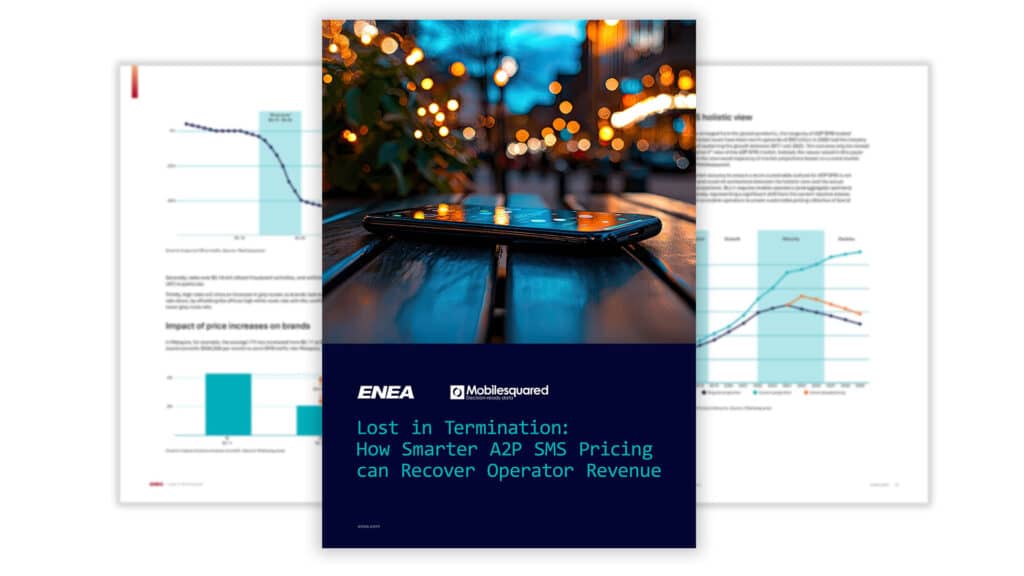
The report by Mobilesquared and Enea provides detailed data for the pricing mechanisms of A2P SMS and compares revenue forecasts for flat and value-based A2P SMS pricing scenarios.