The secret to unlocking USD 29.4 billion in SMS revenue
Value-based pricing for A2P SMS, part 1: one size does not fit all
Why is value-based pricing needed?
Why do brands opt to pay a premium for A2P SMS messages instead of utilizing free channels like email?
Universal device support and sky-high read rates are often cited as the key reasons. The premium reflects the added value (and revenue) brands get from the ubiquity and effectiveness of SMS channels.
One size does not fit all
Before we proceed, we should remember that not all messages are the same. For a brand, different types of messages carry different values. A message used to authenticate a new customer typically has high importance. If it fails, the customer might abandon the process and take their business elsewhere. Missing out on acquiring a new customer can cost the brand the full lifetime value of that customer. A notification confirming an order, on the other hand, might be less critical since the sale has already been made. Therefore, the premium that brands are willing to pay for SMS depends on the type of message.
Still, all A2P SMS messages are charged the same, regardless of the premium that brands are willing to pay for each message category.
Identifying the problem: flat pricing for A2P SMS drives business away
For brands, this might be acceptable if the prices were low enough to enable them to send any message via SMS. However, the reality is that international termination rates (the costs to send A2P SMS internationally) have skyrocketed since the pandemic and are nearing levels that force brands to seek alternatives. The issue is that these alternatives do not generate revenue for mobile network operators or enhance communication efficiency for brands that would rather stick with SMS if the price were right. In response to rising costs, brands are either migrating to messaging apps like WhatsApp, switching to service providers that use unreliable grey routes to keep prices down, or simply avoiding sending messages altogether. In any of these cases, the MNO receives no revenue from A2P SMS.
Besides losing white-route SMS traffic that brands cannot justify paying higher prices for, flat pricing also removes another monetization opportunity for operators. Some use cases remain so critical to the business that the added value of communicating via SMS outweighs the price premium, justifying the high prices. These business-critical messages are not fully monetized under the current flat pricing model. Operators could raise prices for these messages further without losing traffic.
The solution: value-based pricing optimizes A2P SMS revenue
How can mobile network operators monetize regular SMS traffic that brands aren’t willing to pay as much for, while optimizing revenue from the most valuable traffic? It sounds complicated, but it doesn’t have to be. It’s time for operators to adopt smart, value-based pricing for A2P SMS.
Value-based pricing for A2P SMS means operators set different prices to reflect the price premium brands are willing to pay for various types of messages, such as authentication, promotions, or notifications.
By precisely matching price and value for each category across all SMS messages, operators can maximize their revenue. However, in practice, achieving a perfect match for every message is unlikely. Instead, operators can charge higher rates for critical messages where A2P SMS is more important to brands, and lower rates for other messages. This simply involves identifying two acceptable price levels for brands, one for critical messages and one for non-critical messages.
Segmenting messages into critical and non-critical categories and applying differentiated pricing is also more likely to be accepted by brands. Operators can prioritize critical communication when network load is high, and this, if anything, is an acceptable reason for brands to pay more for critical messages than they normally do.
How to boost revenues with a 130% increase
When mobile network operators increase international termination rates to boost A2P SMS revenue, they risk seeing the opposite effect. A recent report “Lost in Termination: How Smarter A2P SMS Pricing can Recover Operator Revenue” by Enea and Mobilesquared shows that for every $0.01 rise in price above $0.10 per message, traffic drops by 2.9%. The current average price exceeds $0.14. Moreover, high prices encourage the use of grey routes and foster fraud, such as artificial inflation of traffic (AIT). Ultimately, this decline in traffic leads to lower revenue despite higher prices.
The big question, then, is whether value-based pricing can reverse the downward trend. According to the same report, the answer is yes, it can grow revenue. In fact, Mobilesquared estimates that the total spend on international A2P SMS could grow by USD 29.4 billion over five years through implementing value-based pricing. An increase of 130%!
That is revenue just waiting to be monetized by operators. We will discuss how operators can implement value-based pricing in the next part of this article series, but a good start is to download the full report.
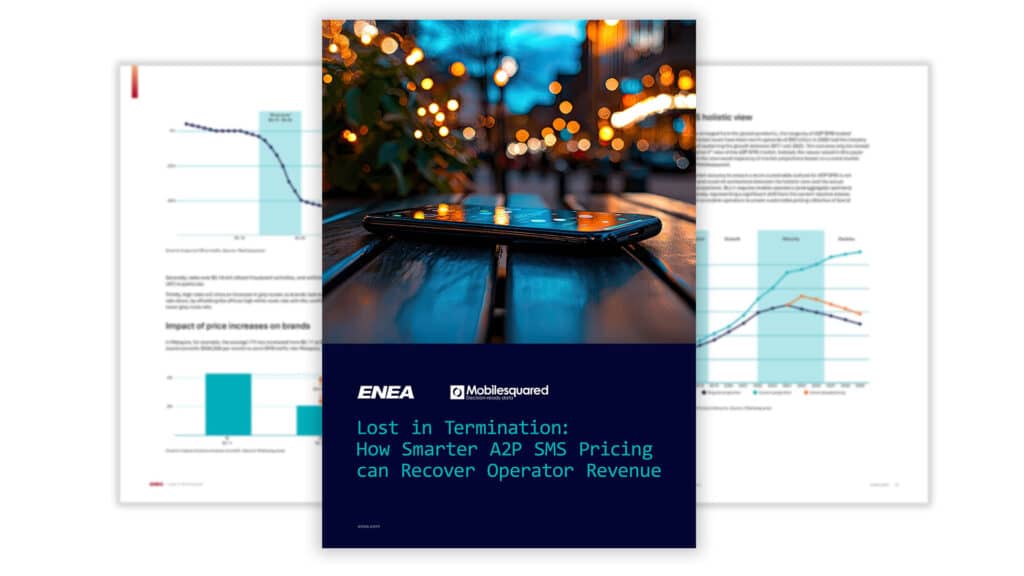
The report by Mobilesquared and Enea provides detailed data for the pricing mechanisms of A2P SMS and compares revenue forecasts for flat and value-based A2P SMS pricing scenarios.