US Tech Versus UK & EU Regulations?
The recent shifts in US trade policy under the new administration may soon ignite a fresh front—not in goods or manufacturing, but in digital regulation. As global governments tighten rules around online privacy, safety, and harmful content, US-based tech companies are increasingly pushing back, citing freedom of speech rights and jurisdictional issues.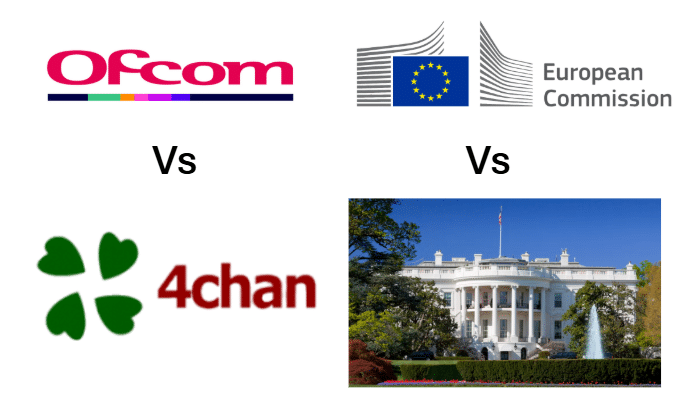
A recent case highlighting this tension is the UK’s regulatory action against 4chan™. The UK’s media watchdog, Ofcom, has launched an investigation into the message board platform, citing:
- Failure to respond to a statutory information request,
- Failure to complete or maintain a sufficient illegal content risk assessment, and
- Non-compliance with safety duties related to illegal content.
As a result, Ofcom has issued a £20,000 fine under the UK’s Online Safety Act. However, 4chan™ has refused to pay, arguing that UK regulations are unenforceable in the US and asserting that the fine infringes on first amendment rights.
Backing from US policymakers appears to be growing. Federal Trade Commission Chairman Andrew Ferguson recently warned US tech firms that complying with certain foreign regulations could violate domestic law, particularly if such compliance compromises privacy or free speech. He stated:
“Foreign governments seeking to limit free expression or weaken data security in the United States might count on the fact that companies have an incentive to simplify their operations and legal compliance measures by applying uniform policies across jurisdictions.”
Teresa Ribera, Executive Vice President of the EU Commission, in a Financial Times interview on Aug 29, responded to the US administration threat of tariffs and other controls on countries whose digital rules discriminate against American firms. The particular focus for the EU, is the Digital Services Act and the Digital Markets Act. “We may be kind, polite, try to find ways to solve problems and discrepancies but we cannot accept whatever [they demand],” the EU’s competition commissioner told the Financial Times. “We cannot be subject to the will of a third country.”
As Ofcom is reviews its position, the broader question now emerges: can national regulators effectively enforce online safety rules on foreign-based tech giants? If self-regulation fails, enforcement could escalate to internet service providers (ISPs) and telecom operators, who may be asked to restrict access based on IP addresses or domain names—raising concerns about censorship, feasibility, and technical capability.
Alternatively, some suggest enforcement could hinge on mechanisms such as age verification and explicit user consent, similar to the UK’s new regulations on online pornography. This would demand advanced traffic management and filtering tools—capabilities that companies like Enea already provide through their existing network traffic solutions.
The evolving situation underscores the growing complexity of internet regulation across borders. Can national fines be enforced internationally? Or will such actions become yet another lever in global trade negotiations? While services have so far been spared from US tariffs, that may not remain the case.
Additional debate on freedom of speech, net neutrality and rights of governments to protect citizens will follow, as highlighted by the EU Competition Commissioner.
The regulator’s next move will be one to watch.