CSP H – LARGE ASIAN BROADBAND OPERATOR
Intelligent IP Address Management
CSP H, a large Asian broadband operator, leveraged the built-in IPv4/v6 DHCP server and business logic engine in Enea AAA Server to create an Advanced IP Address Management (IPAM) function tailored to their unique requirements. At the same time CSP H replaced its legacy systems for AAA and policy management with the Enea platform. Here we will focus on the IPAM aspect.
Explore seven additional case studies by downloading the full Why Intellegent AAA is the Swiss Army Knife of Telecom paper below. You can also go here to learn more about the Enea AAA Server.


Legacy DHCP Server Couldn’t Keep Up with IPv6 Requirements

The CSP H access network had grown organically over many years. Different regions used different operational models, subscriber databases, and address management practices. IPv4 services were delivered through a mixture of legacy DHCP platforms and locally managed address pools, while IPv6 deployment had been introduced incrementally through separate DHCPv6 systems tied to specific access vendors and Broadband Network Gateway (BNG) generations. Subscriber policy and authentication were handled independently by AAA infrastructure with limited integration to address allocation.
As subscriber growth accelerated and IPv6 adoption expanded, operational complexity increased significantly.
The operator faced several persistent problems:
- IPv6 address planning was fragmented across regions and access platforms.
- DHCPv6 allocation behavior differed between vendors and operational domains.
- IPv6 Prefix Delegation, where a client such as a home router, gets an IPv6 range and in turn allocates public IPv6 addresses to attached devices, were difficult to standardize.
- Subscriber traceability required correlating logs across multiple systems.
- High availability was challenging depending on manually managed failover procedures.
- Scaling DHCP infrastructure required increasingly complex pool partitioning and
operational coordination. - Expanding address ranges or introducing new subscriber policies frequently required
maintenance windows.
The legacy DHCP servers, with two nodes in a primary-secondary configuration, suffered from the well-known ‘split brain’ issue where both nodes could consider themselves as the primary node if the connection between them was broken. Since they were optimized for performance, with only an in-memory database, the state of allocated IP addresses could in certain circumstances be lost all together. With IPv4 this had been a tolerable design flaw since the state in most cases could be re-established indirectly through RADIUS communication with the BNGs.
But with extensive usage of dual-stack IPv4/IPv6 came new requirements, especially with IPv6 Prefix Delegation. With IPv6 Prefix Delegation, re-establish state became too complicated, so CSP H looked for a ‘split-brain-safe’ DHCP function. Furthermore, CSP H business side had come with more advanced requirements related to IP management which pointed towards a more intelligent policy-based IP allocation approach with a hierarchical structure rather than the current flat structure.
Policy-Based IP Allocation at the Network Edge

Traditional IP Address Management (IPAM) often relies on standalone DHCP servers that operate in isolation from subscriber identity. By integrating a IPv4/v6 DHCP Server directly into the Enea AAA Server, the process of assigning an IP address is transformed from a basic network function into a policy-driven event orchestrated by the Business Logic Engine.
The Enea AAA Server’s built-in DHCP capability represents a shift from static IP assignment to Intelligent IPAM, where the Business Logic Engine ensures that every IP allocation is a policy-enforced decision.
Key Strategic Advantages
1 – The «Single Source of Truth»:
This approach ensures 100% synchronization between a subscriber’s identity and their assigned IP. This is vital for Lawful Intercept (LI), accurate billing, and troubleshooting.
2 – Policy-Based Precision:
Unlike standard DHCP servers, the Enea Business Logic Engine can drive IP allocation based on real-time criteria such as:
- Subscriber Segment: Assigning different IP pools for Consumer, Corporate, or Wholesale users. No allocation for subscribers on deny-lists (payment pending, banned etc.).
- Network topology and regions: The IP allocation logic had to consider from what network equipment and region the DHCP request originated.
- Prefix IPv6 Delegation: Is the client, e.g. a Home router, entitled to get a whole block (prefix) of IPv6 addresses (e.g., a /56 or /64 prefix) to provide IP allocation for attached devices? If so, what prefix size?
- DNS parameters: Customized DNS settings for different subscriber types.
3 – Hierarchical IP-Allocation structure:
Facilitates administration across different user groups and locations.
4 – Lower Signaling Latency:
Co-locating DHCP with AAA eliminates the «extra hop» to an external server. The IP is assigned the moment the subscriber is authorized, reducing the Time-to-Online.
The operator also wanted to modernize its architecture toward active-active regional operation, eliminating the ‘split-brain’ issues, while preserving strict operational control over address ownership and subscriber policy.
At the core of the deployment was a consensus-based distributed IPAM architecture. Instead of relying on isolated DHCP servers with locally managed pools, the new system established a globally authoritative hierarchical allocation model aligned with CSP H’s network topology.
Address space was organized hierarchically according to the operational structure:
- Region,
- BRAS / BNG,
- Subscriber Segment,
- and Service Policy.
This hierarchy allowed the operator to directly map address ownership to the physical broadband network while maintaining clear aggregation boundaries for routing, operations, and reporting.
The system introduced delegated regional allocation clusters located close to broadband edge infrastructure. Regional allocators received delegated IP allocation slices from a globally synchronized address authority using consensus-based coordination.
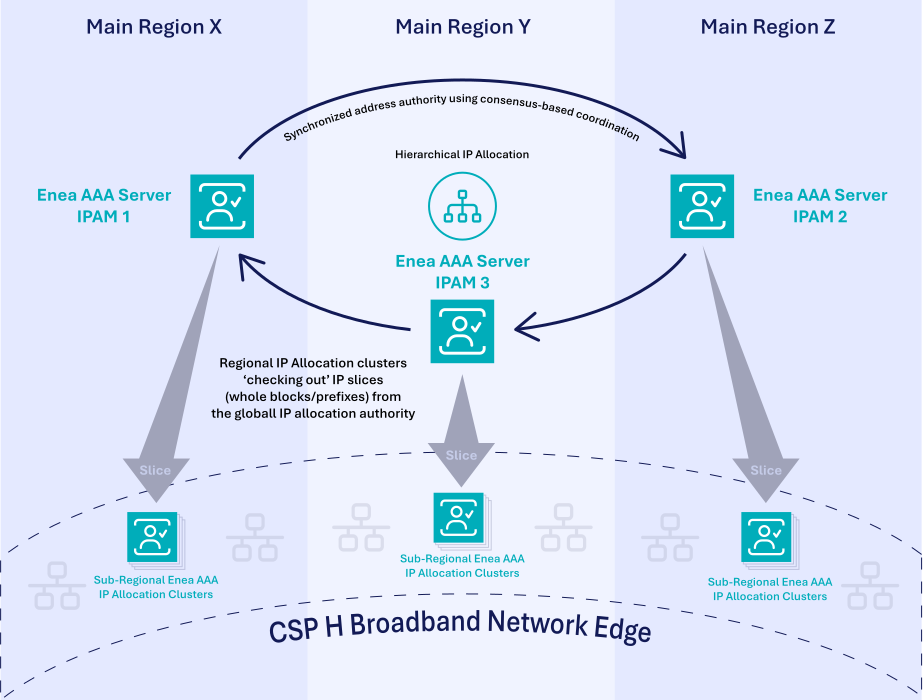
This architecture solved two major problems simultaneously:
- Regional IP Allocation: Local subscriber allocations could be performed with very low latency
and high scale. - Global Address Ownership: IP coordination remained strictly consistent and conflict-free
across the entire network.
Unlike the previous DHCP failover mechanisms, which relied on split pools and asynchronous lease replication, the new platform provided deterministic allocation guarantees through distributed consensus. This eliminated duplicate allocations during failover scenarios and enabled true active-active operation across geographically redundant sites.
CSP H no longer needs to statically partition address pools between servers or regions. Instead, allocation capacity expands dynamically as regional clusters request additional delegated slices from the global hierarchy. Address utilization has improved significantly, while operational overhead associated with manual pool management has been greatly reduced.
Integrated AAA capabilities further simplifies operations. Subscriber identity, authorization policy, IPv6 prefix delegation behavior, and service classification are now evaluated within a single policy framework.
The Enea AAA’s integrated DHCPv6 engine supports both IA_NA (Identity Association for Non-Temporary Address) for WAN connectivity and IA_PD (Identity Association for Prefix Delegation) for residential networking. By utilizing the Business Logic Engine, CSPs can dynamically manage prefix sizes based on subscriber profiles, ensuring efficient address utilization.
Relay metadata from BNGs — including relay link-address, Interface-ID, and subscriber identifiers — allowed the Enea AAA Server to automatically determine the correct allocation hierarchy and subscriber policy for each request.
This enabled consistent enforcement of:
- Segmentation: Residential versus business and wholesale policies.
- Service-level IP Pool Selection: Dynamically assigning subscribers to specific IP pools that trigger distinct contention ratios and QoS priorities within the network core.
- For IPv6: Identity Association for Non-Temporary Access – IA_NA (home router’s IP) versus Identity Association for Prefix Delegation – IA_PD (the home network block) allocation behavior.
- Topology-aware prefix delegation strategies.
CSP H also gains much stronger subscriber traceability. Because address management, lease state, and subscriber identity are unified within the same distributed system, operational teams can quickly correlate subscriber sessions, delegated prefixes, access nodes, and authentication records without stitching together data from multiple legacy platforms. This simplified tracking for regulatory compliance.
From an operational perspective, one of the largest improvements is the elimination of maintenance-related service disruption. Address ranges can be expanded dynamically within the hierarchy without interrupting active subscriber sessions. New BNGs and regional access domains could be introduced simply by extending the address hierarchy and policy tree rather than deploying isolated DHCP infrastructure.
The new Enea IPAM solution provides:
- Geo-redundant active-active operation.
- Topology-aware hierarchical IPv6 management.
- Low-latency regional IP allocation.
- Integrated subscriber policy control.
- Carrier-grade fault tolerance.
- Unified architecture designed specifically for large-scale broadband networks.
For CSP H, the transition was not merely a DHCP replacement project. It became a foundational modernization of subscriber identity, address management, and broadband service control for the IPv6 era.
A Strategic Guide to AAA Replacement
Legacy AAA systems are struggling to keep up with increasing data volumes, cloud-native architectures, rising complexity, and ever-increasing operational costs. This white paper gives CSPs practical insights on when and how to modernize their AAA infrastructure – delivering higher performance, greater flexibility, lower TCO, and a future-proof foundation for next-generation services.
Access
Why Intelligent AAA is the Swiss Army Knife of Telecom
The AAA server is no longer a static gatekeeper. It's now a Programmable Core capable of intelligent mediation, multi-generation interworking, and policy-driven orchestration at the network edge. Drawing on 8 Tier 1 operator case studies, this white paper shows how the Enea AAA Server turns operational complexity into scalable, revenue-generating services.
Access