Chapter 6 – Mobile Network Integration
Satellite NTN Architectures
Incorporating LEO D2C Satellites

Two Modes of Operation in the Mobile Network
The NTN Control Function (NCF) is a vital component of a satellite network, responsible for managing and coordinating the network’s operations by controlling the space-borne or airborne vehicles and radio resources. It provides essential data to ground-based base stations, such as satellite position (ephemeris data), and handles tasks like managing handover procedures for ground devices to ensure seamless connectivity as the satellite moves.
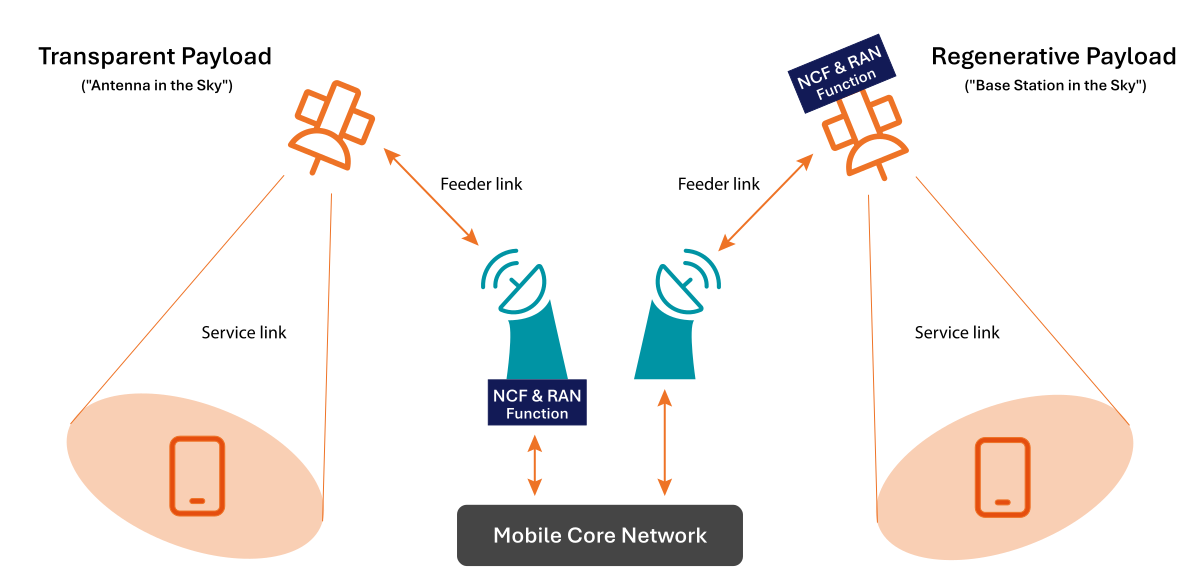
NTN D2C satellites can operate in two main configurations to extend the terrestrial cellular Radio Access Network (RAN).
1. Transparent Payload («Antenna in the Sky»)
Here, the satellite acts primarily as an RF repeater or «bent-pipe» relay, amplifying and forwarding signals between the device and ground gateway without on-board base station functions. All baseband processing and higher-layer management are conducted by the ground gateway or terrestrial network elements.
2. Regenerative Payload («Base Station in the Sky»)
This mode involves onboard processing capabilities such as demodulation, scheduling, and radio resource management, similar to terrestrial base stations. It processes Layer 2 and 3 signaling, managing connections and mobility directly, which reduces latency for some functions but requires more sophisticated satellite technology.
Two Models of Cooperation Between Satellite Providers and MNOs
The integration of satellite providers in mobile network architecture can occur in two primary ways
1. RAN Extension (Utilizing MNO’s Mobile Core)
This model fully integrates satellite systems with the mobile operator’s core network, functioning as an extension of the RAN. The satellite provider uses ground stations to route traffic securely to the operator’s core network and performs radio gateway functions and protocol translations from satellite-specific formats to those compatible with the mobile network. In this setup, the satellite provider does not require its own core network, as all call processing, authentication, billing, and session management are handled by the operator’s core.
2. Roaming Partner (Own Mobile Core)
In this model, satellite providers operate independently, maintaining their own core networks and engaging with MNOs through GSMA-standard roaming agreements. Additionally, this setup will potentially allow the satellite provider to act as an MNO or, more commonly, as an MVNO, targeting end-users directly while also collaborating with existing mobile network operators.
The initial implementations of NTN D2C followed the RAN Extension model, illustrated by collaborations such as SpaceX with T-Mobile and KDDI, and AST SpaceMobile with AT&T, Vodafone, and Telefónica.
In these arrangements, satellite providers depend on the mobile operators’ core networks to deliver their services.
For obvious reasons this model does not scale well having to integrate with each mobile operator, and will only work for the spectrum sharing approach.
The Roaming Partner model initially addressed IoT connectivity in areas lacking terrestrial networks, with providers like Iridium and Sateliot, but has quickly become popular also with providers such as AST SpaceMobile and Starlink deploying their own core networks.